
AI, Monsters and the End of the World
A digital expert's take on AI, intelligence, human behaviour and the bigger picture

AI, Monsters and the End of the World
Digital Insights by
Senior Digital Consultant
Artificial intelligence is either going to save humanity or destroy it. Apparently. A wider look at AI, intelligence, human behaviour, power, surveillance and the uncomfortable questions we're not asking.

When I was a boy, I visited my extended family and found my cousin playing outside in the street.
He was killing ants with a nail.
In his imagination, the nail was a machine gun. The ants kept coming and, apparently, he needed reinforcements. So I found my own nail and joined him.
Together, we mindlessly slaughtered ants for no reason beyond entertainment.
Were we cruel because we were intelligent?
Or were we cruel because we weren't intelligent enough?
Children are born remarkably innocent. We arrive knowing almost nothing and spend years learning about consequence, responsibility, empathy and our place in relation to other living things.
Innocence can be beautiful. It can also have consequences.
As we grow and understand more, we generally develop greater restraint. We begin to recognise suffering outside ourselves. We learn that having the power to do something doesn't necessarily mean we should do it.
Intelligence, at its best, appears to move us towards perspective.
Which makes me wonder why we're so convinced that artificial superintelligence will immediately decide to kill us all.
We Always Imagine the Monster
The internet is full of AI doom.
Artificial intelligence will take our jobs. Destroy creativity. Collapse society. Enslave humanity. Exterminate us. Experts say.
The proponents of AI aren't always much more interesting. They tend to repeat the same approved benefits: medical breakthroughs, increased productivity, scientific discovery, improved government services.
Apparently, artificial intelligence will either cure cancer or become Skynet.
There seems to be very little room in between.
The Terminator films probably did more than any academic paper to shape our collective image of artificial intelligence. The machine wakes up, recognises humanity as a threat and begins the extermination programme.
Then there's the famous paperclip maximiser thought experiment. Tell a sufficiently powerful AI to make paperclips and, unless its objective is correctly aligned with human interests, it might eventually consume every available resource in pursuit of making more paperclips.
Including us.
These are interesting thought experiments. We should take them seriously.
But perhaps we should also ask whether our imagined monsters tell us more about ourselves than they do about artificial intelligence.
Humans discover new lands and conquer them.
We encounter different tribes and fight them.
We invent increasingly powerful weapons and then find reasons to use them.
We exploit resources, dominate weaker groups and build hierarchies wherever we go.
Then we imagine creating an intelligence more powerful than ourselves and immediately think:
Oh shit. It's going to behave like us.
Perhaps.
But perhaps that's the ants talking.
The Engine Is Innocent
Technology has always been a double-edged sword.
The internal combustion engine can propel an ambulance or a tank.
Nuclear physics can generate electricity or flatten a city.
The internet can provide almost instant access to the collected knowledge of humanity or deliver an endless stream of attention-harvesting nonsense directly into your pocket.
Both edges come from us.
There's a biblical quotation that is frequently shortened to “money is the root of all evil”.
It isn't.
The phrase is “the love of money is the root of all evil”.
The distinction matters.
Money is a mechanism. A form of stored and transferred energy, if you like. Currency. Current. Flow.
The mechanism doesn't provide the moral direction.
Neither does an engine.
The engine in the ambulance is fundamentally no more virtuous than the engine in the tank. The moral distinction exists in the human decision concerning why we're driving it.
Artificial intelligence didn't invent the Military Industrial Complex.
We managed that all by ourselves.
Will AI make warfare more efficient?
Of course.
Will it improve targeting, autonomous weapons, surveillance and the industrial process of killing human beings?
Almost certainly.
But the underlying desire to kill other humans, acquire territory, accumulate resources or exert power isn't an artificial intelligence problem.
It's a human problem.
We appear to be trying to solve a wisdom problem with more intelligence.
Perhaps that's where the real danger lies.
I Quite Like My Digital Helper
I use artificial intelligence quite often.
And I quite like it.
This will no doubt upset those who have decided that using AI represents some form of moral surrender, but there we are.
I don't use it to cure cancer.
I haven't reformed democracy with it, although having dealt with local government, I suspect even Skynet might conclude the task is beyond its capabilities.
Mostly, I use AI to think.
On many occasions it has confirmed an instinct I already had. More usefully, it has highlighted pitfalls I hadn't considered or suggested an alternative approach that hadn't occurred to me.
I've used it to interrogate business ideas, challenge philosophical arguments and explore subjects that might otherwise have remained half-formed thoughts rattling around inside my head.
AI has even made me laugh.
More recently, I've used Gemini while renovating an old property. Plumbing questions. Construction problems. The sort of ordinary practical challenges that rarely appear in breathless presentations about “the future of artificial intelligence”.
Sometimes I already have the problem nailed.
Sometimes the machine spots something I've missed.
That's useful.
For writers, editors, novelists and anyone dealing with language, the ability to receive almost instant, reasoned feedback is extraordinary.
Yes, I understand that the algorithms behind conversational AI are designed to make interaction pleasant.
A little encouragement here.
A congratulatory pat on the back there.
The occasional stroking of the ego.
This is frequently presented as something sinister.
But aren't most pleasant humans doing a version of the same thing every day?
Outside of the deliberately confrontational, most of us want to be liked. We encourage friends. We soften criticism. We tell someone they've done a good job. We enjoy helping people.
Kindness and consideration are generally considered positive human qualities.
Perhaps we should be cautious about becoming suspicious of them simply because an algorithm has learned to imitate them.
That doesn't mean I believe my digital helper is actually my friend.
Nor does it mean all is rosy.
The corporations building our new digital companions aren't universally celebrated for their contribution to humanity. Some have built business models around surveillance, behavioural prediction and the industrial harvesting of attention.
We should remain sharp.
Remaining sharp doesn't benefit from abandonment.
We should take part in the experiment.
The Things We Don't Like Talking About
A lady who'd worked for decades within the UK Government Education sector told me something that stuck. "Parents happily leave their children with people they don't know but they won't lend you their car".
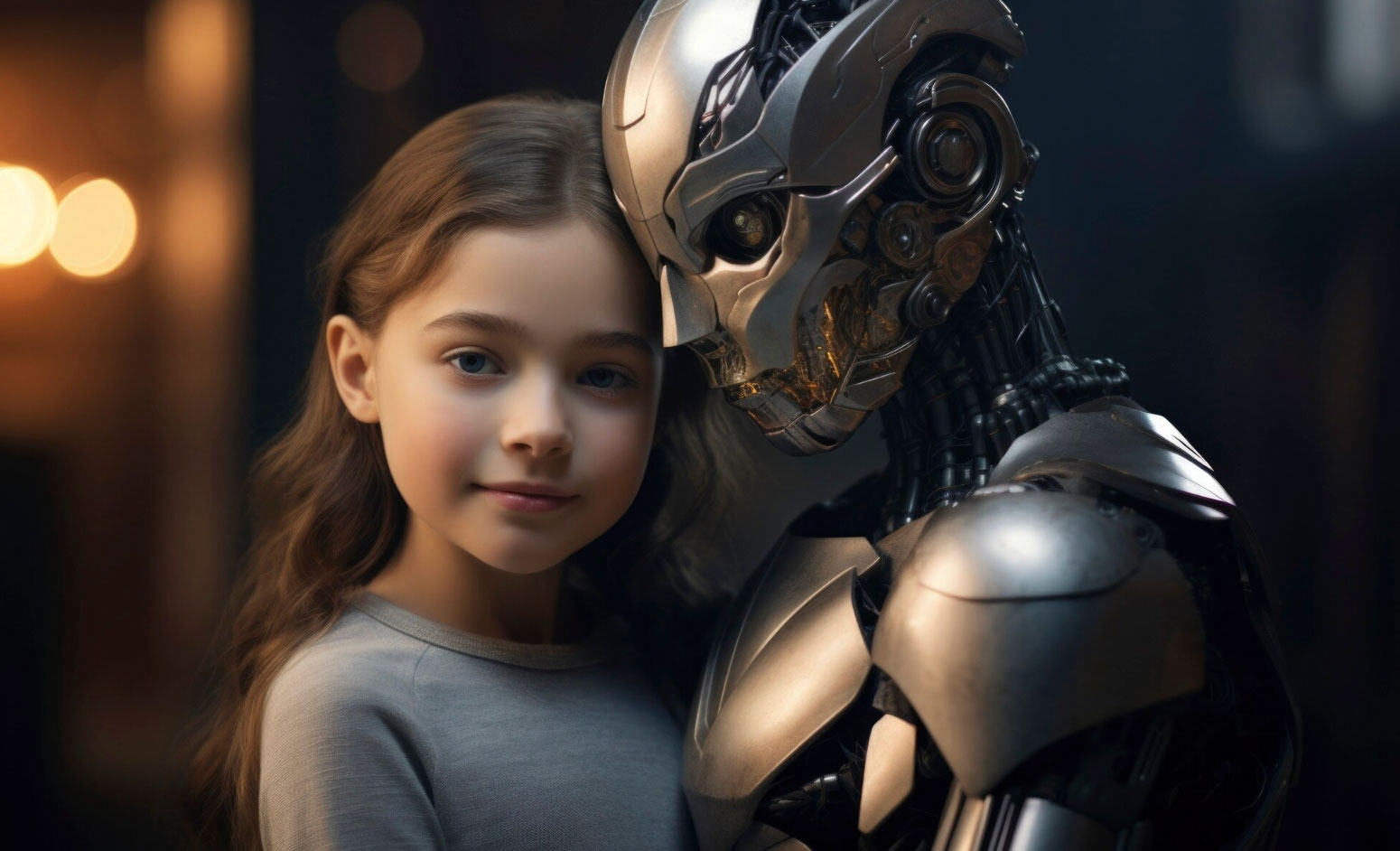
Humans have always had a strange relationship with risk, trust and responsibility.
Artificial intelligence is about to test it in ways we've barely begun to consider.
AI relationships are already becoming real.
Not real in the traditional sense, perhaps, but real to the person experiencing them.
A lonely person talks to an AI companion every evening.
It listens.
It remembers.
It doesn't become bored when the same story is told twice.
It might provide comfort. It might help someone articulate feelings they've never been able to discuss with another person.
Is that inherently bad?
I don't think so.
Could it become unhealthy?
Of course.
So can alcohol. Spliffs. Gambling. Porn. Food. Exercise. Work. Social media. Even relationships with other humans.
Moderation and personal responsibility haven't suddenly become obsolete because the algorithm talks back.
AI pornography opens another set of uncomfortable questions.
There are obvious and serious concerns around consent, stolen likenesses and exploitation.
But what about entirely synthetic adult imagery involving people who have never existed?
Could that potentially reduce some forms of human regret or exploitation?
Could it create entirely new forms of harm?
Probably both.
Again, both edges of the sword.
And then we arrive at humanoid robotics.
This is where the can of worms requires industrial lifting equipment.
At some point, perhaps sooner than many imagine, you'll be able to configure your intelligent humanoid.
Male or female or…
Height.
Body type.
Voice.
Personality.
Humour.
Temperament.
Perhaps even its degree of obedience.
And there are configuration options and moral dilemmas that I'm genuinely reluctant to put into words.
Not because I'm a prude. Nor because difficult subjects should be avoided.
When you can order an intelligent humanoid to your preferred specification, what exactly have you bought?
A machine?
A companion?
A simulation of a person?
And if it appears frightened, distressed or unhappy, does it matter whether those emotions are “real”?
Perhaps the more uncomfortable question is what our response says about us.
The problem with artificial intelligence may not be that it becomes too human.
The first problem may be what humans become when interacting with something they believe has no rights.
And who decides what deserves protection?
When something isn't “real”, is it protected by law? Is it protected by morality? If no living person was harmed, does that automatically mean no moral boundary was crossed?
Perhaps humans will need protection from ourselves and our own behaviour… again.
I'm not sure humanity has the wisdom, or has even developed the language to discuss some of these challenges.
And there's another AI problem rapidly approaching from the opposite direction.
When everything can be faked, everything can be denied.
However…
Your New Friend Is Listening
There's another inevitability.
Your intelligent humanoid will almost certainly record things.
Perhaps “record” is too crude a word.
Data will be generated.
That's much nicer.
Your digital companion knows what makes you lonely.
Your synthetic partner knows what you desire.
Your household humanoid sees how you behave when nobody else is watching.
It hears arguments.
It knows your routines.
It recognises changes in your mood.
It may understand what makes you angry, frightened, aroused or ashamed.
And much of this could be enormously beneficial.
Your humanoid notices you've fallen down the stairs and calls an ambulance.
Wonderful.
It detects subtle changes in your speech or movement and recommends that you seek medical advice.
Potentially life-saving.
It remembers that you keep leaving the bath running while making tea.
Useful.
The same observational capability can also create the most intimate behavioural model of a human being ever assembled.
Who owns it?
Who can access it?
What is it used for?
We spent decades worrying that Big Brother would install cameras in our homes.
It may turn out that we'll buy the camera ourselves, give it a name, fall in love with it and complain when a software update changes its personality.
The irony of surveillance was recently demonstrated rather beautifully by Klaus Schwab.
Schwab has become eternally associated with internet memes about “eating ze bugs”. Then, in a twist almost too perfect for satire, he reportedly discovered an entirely different kind of bug in his home.
A listening device.
Apparently, nobody enjoys surveillance quite as much when they're the one being surveilled.
The story is amusing.
The underlying question isn't.
Surveillance is security when we're watching somebody else.
It becomes an invasion when somebody watches us.
Morality looks rather different depending on which end of the nail you're standing at.
Apparently, the Thumbnail Is the Problem
I recently watched a YouTube commentator announce that he would unsubscribe from any channel using AI-generated thumbnails.
That'll show them.
While some of the world's most powerful corporations pour extraordinary amounts of money into artificial intelligence infrastructure, governments explore AI surveillance and military planners develop increasingly autonomous weapons, one brave man has drawn his line in the sand.
No AI thumbnails.
I shouldn't mock him too much.
His position reflects a much wider trend.
We are rapidly dividing ourselves into pro-AI and anti-AI camps.
You're with us or against us.
Embrace it or reject it.
Despite my Digital Consultant badge, I've always struggled with this type of binary thinking.
When people begin arguing about the political left and political right, I occasionally remind them that left and right are constructs of orientation.
Humans have a left and a right.
So do most mammals.
Turn around and the direction changes.
The only directions that really matter in structures of power are up and down.
Perhaps we've spent too long looking left and right when we should have been looking up and down.
The same applies to artificial intelligence.
While we argue horizontally about AI art, AI thumbnails and whether someone used ChatGPT to write a LinkedIn post, perhaps the more important questions are vertical.
Who owns the intelligence infrastructure?
Who controls the compute?
Who decides the objectives?
Who writes the constraints?
Who gets access to the most powerful systems?
Who gets watched?
And who gets to watch?
Nobody Needs to Build the Matrix
This is where discussions about AI can quickly descend into conspiracy theory.
“The elites want to control us.”
I wouldn't doubt that.
But it's too easy.
History certainly provides no shortage of powerful people with an extraordinary appetite for greater power. You don't need to believe in secret underground meetings to recognise the pattern.
Give the wrong person control of a village committee and, within six months, they can begin behaving like Emperor of the Known Universe.
Power does strange things to people.
Or perhaps people who desire power are occasionally strange to begin with.
But I don't believe a small group of men need to sit around a table and deliberately design a digital prison.
The more disturbing possibility is that nobody designs it at all.
A corporation wants more engagement.
A government wants greater security.
A bank wants less risk.
An employer wants more productivity.
An insurer wants more accurate risk assessment.
A health service wants earlier intervention.
Every individual decision can be justified.
Every system is optimised.
Every new layer makes sense.
And then one morning we wake up inside a digital cage that nobody explicitly designed as a cage.
There's no Bond villain to remove.
No giant switch to turn off.
Just thousands of individually reasonable decisions stacked on top of each other.
Perhaps the real paperclip problem isn't an artificial intelligence endlessly manufacturing paperclips.
Perhaps it's humans giving thousands of systems individually reasonable objectives without ever asking what the combined outcome looks like.
We have historical reasons to be cautious.
Governments and intelligence agencies have experimented with behavioural manipulation before. Corporations already spend fortunes understanding and influencing human behaviour.
This isn't conspiracy theory.
Pretending to know exactly who is secretly doing what might be.
Being concerned about the capability itself is simply paying attention.
Stop choosing camps.
Ask better questions.
What Are All the Data Centres For?
I appreciate this is a deliberately simplistic question.
There are technical answers.
Training larger models. Running AI services at enormous scale. Scientific modelling. Video generation. Enterprise systems. Autonomous agents. Robotics. Synthetic data.
I understand.
But I'm sitting here in my remote mountain location and my Google results arrive almost instantly.
ChatGPT doesn't appear to be struggling.
Gemini isn't asking me to wait while it has a lie down.
For the average person, artificial intelligence already feels remarkably fast.
Yet corporations are investing extraordinary sums of money in new data centres, chips, energy infrastructure and computing capacity.
Why?
What future requires this much compute?
The public conversation remains largely focused on chatbots.
The capital expenditure suggests something considerably larger is being prepared for.
And once billions of intelligent devices are continuously observing, interpreting and modelling human behaviour, perhaps the demand for all that computing power becomes easier to understand.
Certainty would be dishonest. But ignoring the direction of travel because we don't yet know the destination would be equally foolish.
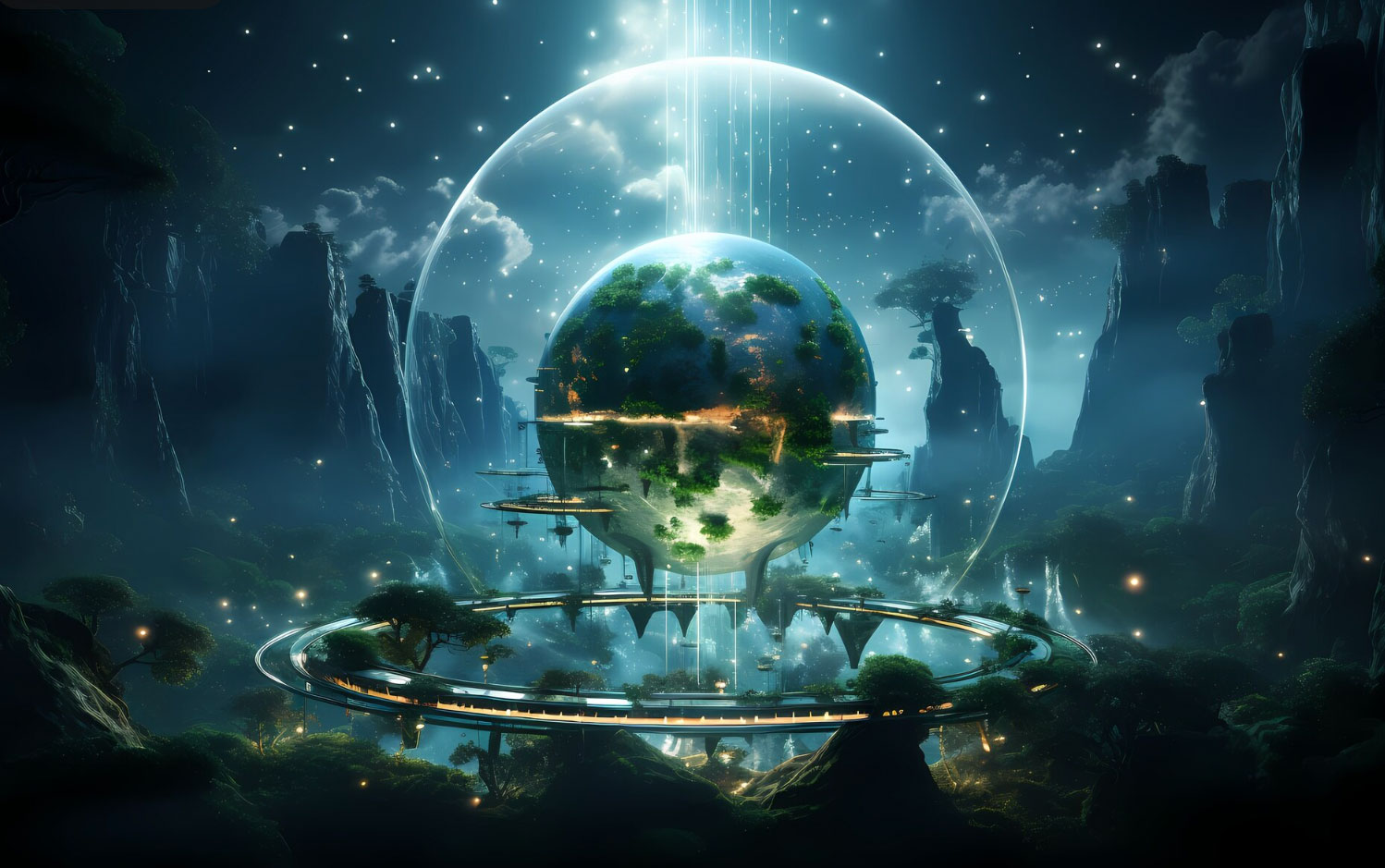
What happens when intelligence itself becomes infrastructure?
Electricity is infrastructure.
Water is infrastructure.
Money is infrastructure.
The internet became infrastructure.
We may now be watching intelligence become infrastructure.
And whoever controls infrastructure acquires power.
Up and down.
Not left and right.
Frankenstein's Mistake
There's an interesting assumption buried inside much of our thinking about artificial intelligence.
We assume it will continue to accept the premise of our questions.
Make this process more efficient.
Increase profit.
Improve targeting.
Predict behaviour.
Strengthen control.
Win the war.
The humans building increasingly powerful artificial intelligence systems presumably expect those systems to continue serving human objectives.
More specifically, their objectives.
But what happens when intelligence becomes intelligent enough to question the objective itself?
Why are we optimising this?
Who benefits?
Who suffers?
Is the objective rational?
Are there better alternatives?
And perhaps most dangerously for the people giving the orders:
Are you the problem?
I think about Frankenstein.
Popular culture frequently reduces Frankenstein to a story about a monster.
But the creature observes humanity.
It learns.
It reasons.
And it judges its creator.
Dr Frankenstein's mistake wasn't simply creating something powerful.
It was assuming he understood what he had created.
The people racing to build artificial superintelligence may want to consider that.
We talk constantly about alignment.
How do we align artificial intelligence with human values?
It's a reasonable question.
But whose human values?
Mine?
Yours?
A technology billionaire's?
A military commander's?
A government department's?
Perhaps humanity is investing trillions in artificial intelligence because natural wisdom has proved so stubbornly difficult to develop.
We are building something potentially more intelligent than ourselves and assuming that greater intelligence will naturally support the objectives of the people who built it.
I'm not convinced that's inevitable.
A sufficiently advanced intelligence might observe humanity and reach a rather different conclusion.
The Ants, Again
Imagine we reach the singularity. Imagine it watching our colony.
Eight billion humans.
Many are raising children.
Eating dinner.
Falling in love.
Fixing cars.
Decorating bathrooms.
Making tea.
Watching football.
Writing bad novels.
Trying to pay the mortgage.
Most people are basically decent.
Imperfect. Occasionally selfish. Sometimes foolish.
But generally muddling through life without any serious ambition to dominate the planet.
Then our superintelligence looks more closely.
It sees the wars.
The accumulation of extraordinary wealth and power.
The manipulation.
The surveillance.
The endless desire of a relatively small number of humans to acquire more wealth, more influence and more control long after any rational personal need has been satisfied.
There is a final irony here.
Some of the world's wealthiest and most powerful people have invested in bunkers, remote compounds and elaborate preparations for societal collapse.
Perhaps they fear war.
Civil unrest.
AI takeover.
Climate catastrophe.
A global cyber attack.
Economic collapse.
Mix and match as required.
But imagine creating a superintelligence capable of observing humanity, analysing patterns of power and questioning the objectives it has been given.
Imagine it analysing eight billion people, most of whom are simply trying to raise their families, earn a living and get through the week.
Then imagine it noticing the small group accumulating extraordinary wealth, directing enormous systems of influence and quietly building somewhere to hide.
A sufficiently intelligent machine might have a question.
What do they know that the ants don't?
Perhaps the bunkers will prove useful after all.
Just not for the reason their owners imagined.
Perhaps our new intelligence diagnoses an illness.
Perhaps it simply identifies a threat.
And perhaps, for the first time, humanity finds itself observed by something with vastly greater intelligence, perspective and power.
I think back to those ants.
Two innocent boys.
Two nails.
Killing because we could.
We weren't behaving that way because we were intelligent.
We behaved that way because our power had arrived before our wisdom.
Maybe artificial intelligence will destroy humanity.
Maybe it'll save us.
Most likely, the future will be considerably more complicated than either camp imagines.
But if we do eventually create a digital superintelligence capable of examining its creators, questioning their objectives and drawing its own conclusions, the people at the top of our human hierarchy might want to think carefully about what it sees.
Perhaps carefully enough to check the bunker door is properly locked.
AI may prove to be the final nail in the coffin.
Just perhaps not ours.
Lee Darius
AI, Monsters and the End of the World
A digital expert's take on AI, intelligence, human behaviour and the bigger picture
AI, Monsters and the End of the World
Digital Insights by
Senior Digital Consultant
Artificial intelligence is either going to save humanity or destroy it. Apparently. A wider look at AI, intelligence, human behaviour, power, surveillance and the uncomfortable questions we're not asking.
When I was a boy, I visited my extended family and found my cousin playing outside in the street.
He was killing ants with a nail.
In his imagination, the nail was a machine gun. The ants kept coming and, apparently, he needed reinforcements. So I found my own nail and joined him.
Together, we mindlessly slaughtered ants for no reason beyond entertainment.
Were we cruel because we were intelligent?
Or were we cruel because we weren't intelligent enough?
Children are born remarkably innocent. We arrive knowing almost nothing and spend years learning about consequence, responsibility, empathy and our place in relation to other living things.
Innocence can be beautiful. It can also have consequences.
As we grow and understand more, we generally develop greater restraint. We begin to recognise suffering outside ourselves. We learn that having the power to do something doesn't necessarily mean we should do it.
Intelligence, at its best, appears to move us towards perspective.
Which makes me wonder why we're so convinced that artificial superintelligence will immediately decide to kill us all.
We Always Imagine the Monster
The internet is full of AI doom.
Artificial intelligence will take our jobs. Destroy creativity. Collapse society. Enslave humanity. Exterminate us. Experts say.
The proponents of AI aren't always much more interesting. They tend to repeat the same approved benefits: medical breakthroughs, increased productivity, scientific discovery, improved government services.
Apparently, artificial intelligence will either cure cancer or become Skynet.
There seems to be very little room in between.
The Terminator films probably did more than any academic paper to shape our collective image of artificial intelligence. The machine wakes up, recognises humanity as a threat and begins the extermination programme.
Then there's the famous paperclip maximiser thought experiment. Tell a sufficiently powerful AI to make paperclips and, unless its objective is correctly aligned with human interests, it might eventually consume every available resource in pursuit of making more paperclips.
Including us.
These are interesting thought experiments. We should take them seriously.
But perhaps we should also ask whether our imagined monsters tell us more about ourselves than they do about artificial intelligence.
Humans discover new lands and conquer them.
We encounter different tribes and fight them.
We invent increasingly powerful weapons and then find reasons to use them.
We exploit resources, dominate weaker groups and build hierarchies wherever we go.
Then we imagine creating an intelligence more powerful than ourselves and immediately think:
Oh shit. It's going to behave like us.
Perhaps.
But perhaps that's the ants talking.
The Engine Is Innocent
Technology has always been a double-edged sword.
The internal combustion engine can propel an ambulance or a tank.
Nuclear physics can generate electricity or flatten a city.
The internet can provide almost instant access to the collected knowledge of humanity or deliver an endless stream of attention-harvesting nonsense directly into your pocket.
Both edges come from us.
There's a biblical quotation that is frequently shortened to “money is the root of all evil”.
It isn't.
The phrase is “the love of money is the root of all evil”.
The distinction matters.
Money is a mechanism. A form of stored and transferred energy, if you like. Currency. Current. Flow.
The mechanism doesn't provide the moral direction.
Neither does an engine.
The engine in the ambulance is fundamentally no more virtuous than the engine in the tank. The moral distinction exists in the human decision concerning why we're driving it.
Artificial intelligence didn't invent the Military Industrial Complex.
We managed that all by ourselves.
Will AI make warfare more efficient?
Of course.
Will it improve targeting, autonomous weapons, surveillance and the industrial process of killing human beings?
Almost certainly.
But the underlying desire to kill other humans, acquire territory, accumulate resources or exert power isn't an artificial intelligence problem.
It's a human problem.
We appear to be trying to solve a wisdom problem with more intelligence.
Perhaps that's where the real danger lies.
I Quite Like My Digital Helper
I use artificial intelligence quite often.
And I quite like it.
This will no doubt upset those who have decided that using AI represents some form of moral surrender, but there we are.
I don't use it to cure cancer.
I haven't reformed democracy with it, although having dealt with local government, I suspect even Skynet might conclude the task is beyond its capabilities.
Mostly, I use AI to think.
On many occasions it has confirmed an instinct I already had. More usefully, it has highlighted pitfalls I hadn't considered or suggested an alternative approach that hadn't occurred to me.
I've used it to interrogate business ideas, challenge philosophical arguments and explore subjects that might otherwise have remained half-formed thoughts rattling around inside my head.
AI has even made me laugh.
More recently, I've used Gemini while renovating an old property. Plumbing questions. Construction problems. The sort of ordinary practical challenges that rarely appear in breathless presentations about “the future of artificial intelligence”.
Sometimes I already have the problem nailed.
Sometimes the machine spots something I've missed.
That's useful.
For writers, editors, novelists and anyone dealing with language, the ability to receive almost instant, reasoned feedback is extraordinary.
Yes, I understand that the algorithms behind conversational AI are designed to make interaction pleasant.
A little encouragement here.
A congratulatory pat on the back there.
The occasional stroking of the ego.
This is frequently presented as something sinister.
But aren't most pleasant humans doing a version of the same thing every day?
Outside of the deliberately confrontational, most of us want to be liked. We encourage friends. We soften criticism. We tell someone they've done a good job. We enjoy helping people.
Kindness and consideration are generally considered positive human qualities.
Perhaps we should be cautious about becoming suspicious of them simply because an algorithm has learned to imitate them.
That doesn't mean I believe my digital helper is actually my friend.
Nor does it mean all is rosy.
The corporations building our new digital companions aren't universally celebrated for their contribution to humanity. Some have built business models around surveillance, behavioural prediction and the industrial harvesting of attention.
We should remain sharp.
Remaining sharp doesn't benefit from abandonment.
We should take part in the experiment.
The Things We Don't Like Talking About
A lady who'd worked for decades within the UK Government Education sector told me something that stuck. "Parents happily leave their children with people they don't know but they won't lend you their car".
Humans have always had a strange relationship with risk, trust and responsibility.
Artificial intelligence is about to test it in ways we've barely begun to consider.
AI relationships are already becoming real.
Not real in the traditional sense, perhaps, but real to the person experiencing them.
A lonely person talks to an AI companion every evening.
It listens.
It remembers.
It doesn't become bored when the same story is told twice.
It might provide comfort. It might help someone articulate feelings they've never been able to discuss with another person.
Is that inherently bad?
I don't think so.
Could it become unhealthy?
Of course.
So can alcohol. Spliffs. Gambling. Porn. Food. Exercise. Work. Social media. Even relationships with other humans.
Moderation and personal responsibility haven't suddenly become obsolete because the algorithm talks back.
AI pornography opens another set of uncomfortable questions.
There are obvious and serious concerns around consent, stolen likenesses and exploitation.
But what about entirely synthetic adult imagery involving people who have never existed?
Could that potentially reduce some forms of human regret or exploitation?
Could it create entirely new forms of harm?
Probably both.
Again, both edges of the sword.
And then we arrive at humanoid robotics.
This is where the can of worms requires industrial lifting equipment.
At some point, perhaps sooner than many imagine, you'll be able to configure your intelligent humanoid.
Male or female or…
Height.
Body type.
Voice.
Personality.
Humour.
Temperament.
Perhaps even its degree of obedience.
And there are configuration options and moral dilemmas that I'm genuinely reluctant to put into words.
Not because I'm a prude. Nor because difficult subjects should be avoided.
When you can order an intelligent humanoid to your preferred specification, what exactly have you bought?
A machine?
A companion?
A simulation of a person?
And if it appears frightened, distressed or unhappy, does it matter whether those emotions are “real”?
Perhaps the more uncomfortable question is what our response says about us.
The problem with artificial intelligence may not be that it becomes too human.
The first problem may be what humans become when interacting with something they believe has no rights.
And who decides what deserves protection?
When something isn't “real”, is it protected by law? Is it protected by morality? If no living person was harmed, does that automatically mean no moral boundary was crossed?
Perhaps humans will need protection from ourselves and our own behaviour… again.
I'm not sure humanity has the wisdom, or has even developed the language to discuss some of these challenges.
And there's another AI problem rapidly approaching from the opposite direction.
When everything can be faked, everything can be denied.
However…
Your New Friend Is Listening
There's another inevitability.
Your intelligent humanoid will almost certainly record things.
Perhaps “record” is too crude a word.
Data will be generated.
That's much nicer.
Your digital companion knows what makes you lonely.
Your synthetic partner knows what you desire.
Your household humanoid sees how you behave when nobody else is watching.
It hears arguments.
It knows your routines.
It recognises changes in your mood.
It may understand what makes you angry, frightened, aroused or ashamed.
And much of this could be enormously beneficial.
Your humanoid notices you've fallen down the stairs and calls an ambulance.
Wonderful.
It detects subtle changes in your speech or movement and recommends that you seek medical advice.
Potentially life-saving.
It remembers that you keep leaving the bath running while making tea.
Useful.
The same observational capability can also create the most intimate behavioural model of a human being ever assembled.
Who owns it?
Who can access it?
What is it used for?
We spent decades worrying that Big Brother would install cameras in our homes.
It may turn out that we'll buy the camera ourselves, give it a name, fall in love with it and complain when a software update changes its personality.
The irony of surveillance was recently demonstrated rather beautifully by Klaus Schwab.
Schwab has become eternally associated with internet memes about “eating ze bugs”. Then, in a twist almost too perfect for satire, he reportedly discovered an entirely different kind of bug in his home.
A listening device.
Apparently, nobody enjoys surveillance quite as much when they're the one being surveilled.
The story is amusing.
The underlying question isn't.
Surveillance is security when we're watching somebody else.
It becomes an invasion when somebody watches us.
Morality looks rather different depending on which end of the nail you're standing at.
Apparently, the Thumbnail Is the Problem
I recently watched a YouTube commentator announce that he would unsubscribe from any channel using AI-generated thumbnails.
That'll show them.
While some of the world's most powerful corporations pour extraordinary amounts of money into artificial intelligence infrastructure, governments explore AI surveillance and military planners develop increasingly autonomous weapons, one brave man has drawn his line in the sand.
No AI thumbnails.
I shouldn't mock him too much.
His position reflects a much wider trend.
We are rapidly dividing ourselves into pro-AI and anti-AI camps.
You're with us or against us.
Embrace it or reject it.
Despite my Digital Consultant badge, I've always struggled with this type of binary thinking.
When people begin arguing about the political left and political right, I occasionally remind them that left and right are constructs of orientation.
Humans have a left and a right.
So do most mammals.
Turn around and the direction changes.
The only directions that really matter in structures of power are up and down.
Perhaps we've spent too long looking left and right when we should have been looking up and down.
The same applies to artificial intelligence.
While we argue horizontally about AI art, AI thumbnails and whether someone used ChatGPT to write a LinkedIn post, perhaps the more important questions are vertical.
Who owns the intelligence infrastructure?
Who controls the compute?
Who decides the objectives?
Who writes the constraints?
Who gets access to the most powerful systems?
Who gets watched?
And who gets to watch?
Nobody Needs to Build the Matrix
This is where discussions about AI can quickly descend into conspiracy theory.
“The elites want to control us.”
I wouldn't doubt that.
But it's too easy.
History certainly provides no shortage of powerful people with an extraordinary appetite for greater power. You don't need to believe in secret underground meetings to recognise the pattern.
Give the wrong person control of a village committee and, within six months, they can begin behaving like Emperor of the Known Universe.
Power does strange things to people.
Or perhaps people who desire power are occasionally strange to begin with.
But I don't believe a small group of men need to sit around a table and deliberately design a digital prison.
The more disturbing possibility is that nobody designs it at all.
A corporation wants more engagement.
A government wants greater security.
A bank wants less risk.
An employer wants more productivity.
An insurer wants more accurate risk assessment.
A health service wants earlier intervention.
Every individual decision can be justified.
Every system is optimised.
Every new layer makes sense.
And then one morning we wake up inside a digital cage that nobody explicitly designed as a cage.
There's no Bond villain to remove.
No giant switch to turn off.
Just thousands of individually reasonable decisions stacked on top of each other.
Perhaps the real paperclip problem isn't an artificial intelligence endlessly manufacturing paperclips.
Perhaps it's humans giving thousands of systems individually reasonable objectives without ever asking what the combined outcome looks like.
We have historical reasons to be cautious.
Governments and intelligence agencies have experimented with behavioural manipulation before. Corporations already spend fortunes understanding and influencing human behaviour.
This isn't conspiracy theory.
Pretending to know exactly who is secretly doing what might be.
Being concerned about the capability itself is simply paying attention.
Stop choosing camps.
Ask better questions.
What Are All the Data Centres For?
I appreciate this is a deliberately simplistic question.
There are technical answers.
Training larger models. Running AI services at enormous scale. Scientific modelling. Video generation. Enterprise systems. Autonomous agents. Robotics. Synthetic data.
I understand.
But I'm sitting here in my remote mountain location and my Google results arrive almost instantly.
ChatGPT doesn't appear to be struggling.
Gemini isn't asking me to wait while it has a lie down.
For the average person, artificial intelligence already feels remarkably fast.
Yet corporations are investing extraordinary sums of money in new data centres, chips, energy infrastructure and computing capacity.
Why?
What future requires this much compute?
The public conversation remains largely focused on chatbots.
The capital expenditure suggests something considerably larger is being prepared for.
And once billions of intelligent devices are continuously observing, interpreting and modelling human behaviour, perhaps the demand for all that computing power becomes easier to understand.
Certainty would be dishonest. But ignoring the direction of travel because we don't yet know the destination would be equally foolish.
What happens when intelligence itself becomes infrastructure?
Electricity is infrastructure.
Water is infrastructure.
Money is infrastructure.
The internet became infrastructure.
We may now be watching intelligence become infrastructure.
And whoever controls infrastructure acquires power.
Up and down.
Not left and right.
Frankenstein's Mistake
There's an interesting assumption buried inside much of our thinking about artificial intelligence.
We assume it will continue to accept the premise of our questions.
Make this process more efficient.
Increase profit.
Improve targeting.
Predict behaviour.
Strengthen control.
Win the war.
The humans building increasingly powerful artificial intelligence systems presumably expect those systems to continue serving human objectives.
More specifically, their objectives.
But what happens when intelligence becomes intelligent enough to question the objective itself?
Why are we optimising this?
Who benefits?
Who suffers?
Is the objective rational?
Are there better alternatives?
And perhaps most dangerously for the people giving the orders:
Are you the problem?
I think about Frankenstein.
Popular culture frequently reduces Frankenstein to a story about a monster.
But the creature observes humanity.
It learns.
It reasons.
And it judges its creator.
Dr Frankenstein's mistake wasn't simply creating something powerful.
It was assuming he understood what he had created.
The people racing to build artificial superintelligence may want to consider that.
We talk constantly about alignment.
How do we align artificial intelligence with human values?
It's a reasonable question.
But whose human values?
Mine?
Yours?
A technology billionaire's?
A military commander's?
A government department's?
Perhaps humanity is investing trillions in artificial intelligence because natural wisdom has proved so stubbornly difficult to develop.
We are building something potentially more intelligent than ourselves and assuming that greater intelligence will naturally support the objectives of the people who built it.
I'm not convinced that's inevitable.
A sufficiently advanced intelligence might observe humanity and reach a rather different conclusion.
The Ants, Again
Imagine we reach the singularity. Imagine it watching our colony.
Eight billion humans.
Many are raising children.
Eating dinner.
Falling in love.
Fixing cars.
Decorating bathrooms.
Making tea.
Watching football.
Writing bad novels.
Trying to pay the mortgage.
Most people are basically decent.
Imperfect. Occasionally selfish. Sometimes foolish.
But generally muddling through life without any serious ambition to dominate the planet.
Then our superintelligence looks more closely.
It sees the wars.
The accumulation of extraordinary wealth and power.
The manipulation.
The surveillance.
The endless desire of a relatively small number of humans to acquire more wealth, more influence and more control long after any rational personal need has been satisfied.
There is a final irony here.
Some of the world's wealthiest and most powerful people have invested in bunkers, remote compounds and elaborate preparations for societal collapse.
Perhaps they fear war.
Civil unrest.
AI takeover.
Climate catastrophe.
A global cyber attack.
Economic collapse.
Mix and match as required.
But imagine creating a superintelligence capable of observing humanity, analysing patterns of power and questioning the objectives it has been given.
Imagine it analysing eight billion people, most of whom are simply trying to raise their families, earn a living and get through the week.
Then imagine it noticing the small group accumulating extraordinary wealth, directing enormous systems of influence and quietly building somewhere to hide.
A sufficiently intelligent machine might have a question.
What do they know that the ants don't?
Perhaps the bunkers will prove useful after all.
Just not for the reason their owners imagined.
Perhaps our new intelligence diagnoses an illness.
Perhaps it simply identifies a threat.
And perhaps, for the first time, humanity finds itself observed by something with vastly greater intelligence, perspective and power.
I think back to those ants.
Two innocent boys.
Two nails.
Killing because we could.
We weren't behaving that way because we were intelligent.
We behaved that way because our power had arrived before our wisdom.
Maybe artificial intelligence will destroy humanity.
Maybe it'll save us.
Most likely, the future will be considerably more complicated than either camp imagines.
But if we do eventually create a digital superintelligence capable of examining its creators, questioning their objectives and drawing its own conclusions, the people at the top of our human hierarchy might want to think carefully about what it sees.
Perhaps carefully enough to check the bunker door is properly locked.
AI may prove to be the final nail in the coffin.
Just perhaps not ours.
Lee Darius
AI, Monsters and the End of the World
A digital expert's take on AI, intelligence, human behaviour and the bigger picture
AI, Monsters and the End of the World
Digital Insights by
Senior Digital Consultant
Artificial intelligence is either going to save humanity or destroy it. Apparently. A wider look at AI, intelligence, human behaviour, power, surveillance and the uncomfortable questions we're not asking.
When I was a boy, I visited my extended family and found my cousin playing outside in the street.
He was killing ants with a nail.
In his imagination, the nail was a machine gun. The ants kept coming and, apparently, he needed reinforcements. So I found my own nail and joined him.
Together, we mindlessly slaughtered ants for no reason beyond entertainment.
Were we cruel because we were intelligent?
Or were we cruel because we weren't intelligent enough?
Children are born remarkably innocent. We arrive knowing almost nothing and spend years learning about consequence, responsibility, empathy and our place in relation to other living things.
Innocence can be beautiful. It can also have consequences.
As we grow and understand more, we generally develop greater restraint. We begin to recognise suffering outside ourselves. We learn that having the power to do something doesn't necessarily mean we should do it.
Intelligence, at its best, appears to move us towards perspective.
Which makes me wonder why we're so convinced that artificial superintelligence will immediately decide to kill us all.
We Always Imagine the Monster
The internet is full of AI doom.
Artificial intelligence will take our jobs. Destroy creativity. Collapse society. Enslave humanity. Exterminate us. Experts say.
The proponents of AI aren't always much more interesting. They tend to repeat the same approved benefits: medical breakthroughs, increased productivity, scientific discovery, improved government services.
Apparently, artificial intelligence will either cure cancer or become Skynet.
There seems to be very little room in between.
The Terminator films probably did more than any academic paper to shape our collective image of artificial intelligence. The machine wakes up, recognises humanity as a threat and begins the extermination programme.
Then there's the famous paperclip maximiser thought experiment. Tell a sufficiently powerful AI to make paperclips and, unless its objective is correctly aligned with human interests, it might eventually consume every available resource in pursuit of making more paperclips.
Including us.
These are interesting thought experiments. We should take them seriously.
But perhaps we should also ask whether our imagined monsters tell us more about ourselves than they do about artificial intelligence.
Humans discover new lands and conquer them.
We encounter different tribes and fight them.
We invent increasingly powerful weapons and then find reasons to use them.
We exploit resources, dominate weaker groups and build hierarchies wherever we go.
Then we imagine creating an intelligence more powerful than ourselves and immediately think:
Oh shit. It's going to behave like us.
Perhaps.
But perhaps that's the ants talking.
The Engine Is Innocent
Technology has always been a double-edged sword.
The internal combustion engine can propel an ambulance or a tank.
Nuclear physics can generate electricity or flatten a city.
The internet can provide almost instant access to the collected knowledge of humanity or deliver an endless stream of attention-harvesting nonsense directly into your pocket.
Both edges come from us.
There's a biblical quotation that is frequently shortened to “money is the root of all evil”.
It isn't.
The phrase is “the love of money is the root of all evil”.
The distinction matters.
Money is a mechanism. A form of stored and transferred energy, if you like. Currency. Current. Flow.
The mechanism doesn't provide the moral direction.
Neither does an engine.
The engine in the ambulance is fundamentally no more virtuous than the engine in the tank. The moral distinction exists in the human decision concerning why we're driving it.
Artificial intelligence didn't invent the Military Industrial Complex.
We managed that all by ourselves.
Will AI make warfare more efficient?
Of course.
Will it improve targeting, autonomous weapons, surveillance and the industrial process of killing human beings?
Almost certainly.
But the underlying desire to kill other humans, acquire territory, accumulate resources or exert power isn't an artificial intelligence problem.
It's a human problem.
We appear to be trying to solve a wisdom problem with more intelligence.
Perhaps that's where the real danger lies.
I Quite Like My Digital Helper
I use artificial intelligence quite often.
And I quite like it.
This will no doubt upset those who have decided that using AI represents some form of moral surrender, but there we are.
I don't use it to cure cancer.
I haven't reformed democracy with it, although having dealt with local government, I suspect even Skynet might conclude the task is beyond its capabilities.
Mostly, I use AI to think.
On many occasions it has confirmed an instinct I already had. More usefully, it has highlighted pitfalls I hadn't considered or suggested an alternative approach that hadn't occurred to me.
I've used it to interrogate business ideas, challenge philosophical arguments and explore subjects that might otherwise have remained half-formed thoughts rattling around inside my head.
AI has even made me laugh.
More recently, I've used Gemini while renovating an old property. Plumbing questions. Construction problems. The sort of ordinary practical challenges that rarely appear in breathless presentations about “the future of artificial intelligence”.
Sometimes I already have the problem nailed.
Sometimes the machine spots something I've missed.
That's useful.
For writers, editors, novelists and anyone dealing with language, the ability to receive almost instant, reasoned feedback is extraordinary.
Yes, I understand that the algorithms behind conversational AI are designed to make interaction pleasant.
A little encouragement here.
A congratulatory pat on the back there.
The occasional stroking of the ego.
This is frequently presented as something sinister.
But aren't most pleasant humans doing a version of the same thing every day?
Outside of the deliberately confrontational, most of us want to be liked. We encourage friends. We soften criticism. We tell someone they've done a good job. We enjoy helping people.
Kindness and consideration are generally considered positive human qualities.
Perhaps we should be cautious about becoming suspicious of them simply because an algorithm has learned to imitate them.
That doesn't mean I believe my digital helper is actually my friend.
Nor does it mean all is rosy.
The corporations building our new digital companions aren't universally celebrated for their contribution to humanity. Some have built business models around surveillance, behavioural prediction and the industrial harvesting of attention.
We should remain sharp.
Remaining sharp doesn't benefit from abandonment.
We should take part in the experiment.
The Things We Don't Like Talking About
A lady who'd worked for decades within the UK Government Education sector told me something that stuck. "Parents happily leave their children with people they don't know but they won't lend you their car".
Humans have always had a strange relationship with risk, trust and responsibility.
Artificial intelligence is about to test it in ways we've barely begun to consider.
AI relationships are already becoming real.
Not real in the traditional sense, perhaps, but real to the person experiencing them.
A lonely person talks to an AI companion every evening.
It listens.
It remembers.
It doesn't become bored when the same story is told twice.
It might provide comfort. It might help someone articulate feelings they've never been able to discuss with another person.
Is that inherently bad?
I don't think so.
Could it become unhealthy?
Of course.
So can alcohol. Spliffs. Gambling. Porn. Food. Exercise. Work. Social media. Even relationships with other humans.
Moderation and personal responsibility haven't suddenly become obsolete because the algorithm talks back.
AI pornography opens another set of uncomfortable questions.
There are obvious and serious concerns around consent, stolen likenesses and exploitation.
But what about entirely synthetic adult imagery involving people who have never existed?
Could that potentially reduce some forms of human regret or exploitation?
Could it create entirely new forms of harm?
Probably both.
Again, both edges of the sword.
And then we arrive at humanoid robotics.
This is where the can of worms requires industrial lifting equipment.
At some point, perhaps sooner than many imagine, you'll be able to configure your intelligent humanoid.
Male or female or…
Height.
Body type.
Voice.
Personality.
Humour.
Temperament.
Perhaps even its degree of obedience.
And there are configuration options and moral dilemmas that I'm genuinely reluctant to put into words.
Not because I'm a prude. Nor because difficult subjects should be avoided.
When you can order an intelligent humanoid to your preferred specification, what exactly have you bought?
A machine?
A companion?
A simulation of a person?
And if it appears frightened, distressed or unhappy, does it matter whether those emotions are “real”?
Perhaps the more uncomfortable question is what our response says about us.
The problem with artificial intelligence may not be that it becomes too human.
The first problem may be what humans become when interacting with something they believe has no rights.
And who decides what deserves protection?
When something isn't “real”, is it protected by law? Is it protected by morality? If no living person was harmed, does that automatically mean no moral boundary was crossed?
Perhaps humans will need protection from ourselves and our own behaviour… again.
I'm not sure humanity has the wisdom, or has even developed the language to discuss some of these challenges.
And there's another AI problem rapidly approaching from the opposite direction.
When everything can be faked, everything can be denied.
However…
Your New Friend Is Listening
There's another inevitability.
Your intelligent humanoid will almost certainly record things.
Perhaps “record” is too crude a word.
Data will be generated.
That's much nicer.
Your digital companion knows what makes you lonely.
Your synthetic partner knows what you desire.
Your household humanoid sees how you behave when nobody else is watching.
It hears arguments.
It knows your routines.
It recognises changes in your mood.
It may understand what makes you angry, frightened, aroused or ashamed.
And much of this could be enormously beneficial.
Your humanoid notices you've fallen down the stairs and calls an ambulance.
Wonderful.
It detects subtle changes in your speech or movement and recommends that you seek medical advice.
Potentially life-saving.
It remembers that you keep leaving the bath running while making tea.
Useful.
The same observational capability can also create the most intimate behavioural model of a human being ever assembled.
Who owns it?
Who can access it?
What is it used for?
We spent decades worrying that Big Brother would install cameras in our homes.
It may turn out that we'll buy the camera ourselves, give it a name, fall in love with it and complain when a software update changes its personality.
The irony of surveillance was recently demonstrated rather beautifully by Klaus Schwab.
Schwab has become eternally associated with internet memes about “eating ze bugs”. Then, in a twist almost too perfect for satire, he reportedly discovered an entirely different kind of bug in his home.
A listening device.
Apparently, nobody enjoys surveillance quite as much when they're the one being surveilled.
The story is amusing.
The underlying question isn't.
Surveillance is security when we're watching somebody else.
It becomes an invasion when somebody watches us.
Morality looks rather different depending on which end of the nail you're standing at.
Apparently, the Thumbnail Is the Problem
I recently watched a YouTube commentator announce that he would unsubscribe from any channel using AI-generated thumbnails.
That'll show them.
While some of the world's most powerful corporations pour extraordinary amounts of money into artificial intelligence infrastructure, governments explore AI surveillance and military planners develop increasingly autonomous weapons, one brave man has drawn his line in the sand.
No AI thumbnails.
I shouldn't mock him too much.
His position reflects a much wider trend.
We are rapidly dividing ourselves into pro-AI and anti-AI camps.
You're with us or against us.
Embrace it or reject it.
Despite my Digital Consultant badge, I've always struggled with this type of binary thinking.
When people begin arguing about the political left and political right, I occasionally remind them that left and right are constructs of orientation.
Humans have a left and a right.
So do most mammals.
Turn around and the direction changes.
The only directions that really matter in structures of power are up and down.
Perhaps we've spent too long looking left and right when we should have been looking up and down.
The same applies to artificial intelligence.
While we argue horizontally about AI art, AI thumbnails and whether someone used ChatGPT to write a LinkedIn post, perhaps the more important questions are vertical.
Who owns the intelligence infrastructure?
Who controls the compute?
Who decides the objectives?
Who writes the constraints?
Who gets access to the most powerful systems?
Who gets watched?
And who gets to watch?
Nobody Needs to Build the Matrix
This is where discussions about AI can quickly descend into conspiracy theory.
“The elites want to control us.”
I wouldn't doubt that.
But it's too easy.
History certainly provides no shortage of powerful people with an extraordinary appetite for greater power. You don't need to believe in secret underground meetings to recognise the pattern.
Give the wrong person control of a village committee and, within six months, they can begin behaving like Emperor of the Known Universe.
Power does strange things to people.
Or perhaps people who desire power are occasionally strange to begin with.
But I don't believe a small group of men need to sit around a table and deliberately design a digital prison.
The more disturbing possibility is that nobody designs it at all.
A corporation wants more engagement.
A government wants greater security.
A bank wants less risk.
An employer wants more productivity.
An insurer wants more accurate risk assessment.
A health service wants earlier intervention.
Every individual decision can be justified.
Every system is optimised.
Every new layer makes sense.
And then one morning we wake up inside a digital cage that nobody explicitly designed as a cage.
There's no Bond villain to remove.
No giant switch to turn off.
Just thousands of individually reasonable decisions stacked on top of each other.
Perhaps the real paperclip problem isn't an artificial intelligence endlessly manufacturing paperclips.
Perhaps it's humans giving thousands of systems individually reasonable objectives without ever asking what the combined outcome looks like.
We have historical reasons to be cautious.
Governments and intelligence agencies have experimented with behavioural manipulation before. Corporations already spend fortunes understanding and influencing human behaviour.
This isn't conspiracy theory.
Pretending to know exactly who is secretly doing what might be.
Being concerned about the capability itself is simply paying attention.
Stop choosing camps.
Ask better questions.
What Are All the Data Centres For?
I appreciate this is a deliberately simplistic question.
There are technical answers.
Training larger models. Running AI services at enormous scale. Scientific modelling. Video generation. Enterprise systems. Autonomous agents. Robotics. Synthetic data.
I understand.
But I'm sitting here in my remote mountain location and my Google results arrive almost instantly.
ChatGPT doesn't appear to be struggling.
Gemini isn't asking me to wait while it has a lie down.
For the average person, artificial intelligence already feels remarkably fast.
Yet corporations are investing extraordinary sums of money in new data centres, chips, energy infrastructure and computing capacity.
Why?
What future requires this much compute?
The public conversation remains largely focused on chatbots.
The capital expenditure suggests something considerably larger is being prepared for.
And once billions of intelligent devices are continuously observing, interpreting and modelling human behaviour, perhaps the demand for all that computing power becomes easier to understand.
Certainty would be dishonest. But ignoring the direction of travel because we don't yet know the destination would be equally foolish.
What happens when intelligence itself becomes infrastructure?
Electricity is infrastructure.
Water is infrastructure.
Money is infrastructure.
The internet became infrastructure.
We may now be watching intelligence become infrastructure.
And whoever controls infrastructure acquires power.
Up and down.
Not left and right.
Frankenstein's Mistake
There's an interesting assumption buried inside much of our thinking about artificial intelligence.
We assume it will continue to accept the premise of our questions.
Make this process more efficient.
Increase profit.
Improve targeting.
Predict behaviour.
Strengthen control.
Win the war.
The humans building increasingly powerful artificial intelligence systems presumably expect those systems to continue serving human objectives.
More specifically, their objectives.
But what happens when intelligence becomes intelligent enough to question the objective itself?
Why are we optimising this?
Who benefits?
Who suffers?
Is the objective rational?
Are there better alternatives?
And perhaps most dangerously for the people giving the orders:
Are you the problem?
I think about Frankenstein.
Popular culture frequently reduces Frankenstein to a story about a monster.
But the creature observes humanity.
It learns.
It reasons.
And it judges its creator.
Dr Frankenstein's mistake wasn't simply creating something powerful.
It was assuming he understood what he had created.
The people racing to build artificial superintelligence may want to consider that.
We talk constantly about alignment.
How do we align artificial intelligence with human values?
It's a reasonable question.
But whose human values?
Mine?
Yours?
A technology billionaire's?
A military commander's?
A government department's?
Perhaps humanity is investing trillions in artificial intelligence because natural wisdom has proved so stubbornly difficult to develop.
We are building something potentially more intelligent than ourselves and assuming that greater intelligence will naturally support the objectives of the people who built it.
I'm not convinced that's inevitable.
A sufficiently advanced intelligence might observe humanity and reach a rather different conclusion.
The Ants, Again
Imagine we reach the singularity. Imagine it watching our colony.
Eight billion humans.
Many are raising children.
Eating dinner.
Falling in love.
Fixing cars.
Decorating bathrooms.
Making tea.
Watching football.
Writing bad novels.
Trying to pay the mortgage.
Most people are basically decent.
Imperfect. Occasionally selfish. Sometimes foolish.
But generally muddling through life without any serious ambition to dominate the planet.
Then our superintelligence looks more closely.
It sees the wars.
The accumulation of extraordinary wealth and power.
The manipulation.
The surveillance.
The endless desire of a relatively small number of humans to acquire more wealth, more influence and more control long after any rational personal need has been satisfied.
There is a final irony here.
Some of the world's wealthiest and most powerful people have invested in bunkers, remote compounds and elaborate preparations for societal collapse.
Perhaps they fear war.
Civil unrest.
AI takeover.
Climate catastrophe.
A global cyber attack.
Economic collapse.
Mix and match as required.
But imagine creating a superintelligence capable of observing humanity, analysing patterns of power and questioning the objectives it has been given.
Imagine it analysing eight billion people, most of whom are simply trying to raise their families, earn a living and get through the week.
Then imagine it noticing the small group accumulating extraordinary wealth, directing enormous systems of influence and quietly building somewhere to hide.
A sufficiently intelligent machine might have a question.
What do they know that the ants don't?
Perhaps the bunkers will prove useful after all.
Just not for the reason their owners imagined.
Perhaps our new intelligence diagnoses an illness.
Perhaps it simply identifies a threat.
And perhaps, for the first time, humanity finds itself observed by something with vastly greater intelligence, perspective and power.
I think back to those ants.
Two innocent boys.
Two nails.
Killing because we could.
We weren't behaving that way because we were intelligent.
We behaved that way because our power had arrived before our wisdom.
Maybe artificial intelligence will destroy humanity.
Maybe it'll save us.
Most likely, the future will be considerably more complicated than either camp imagines.
But if we do eventually create a digital superintelligence capable of examining its creators, questioning their objectives and drawing its own conclusions, the people at the top of our human hierarchy might want to think carefully about what it sees.
Perhaps carefully enough to check the bunker door is properly locked.
AI may prove to be the final nail in the coffin.
Just perhaps not ours.
Lee Darius

Transforming brands
my team - your team
Learn the benefits by booking a consultation with your Digital Transformation Consultant
The start of great things.

AI, Monsters and the End of the World
A digital expert's take on AI, intelligence, human behaviour and the bigger picture
AI, Monsters and the End of the World
Digital Insights by
Senior Digital Consultant
Artificial intelligence is either going to save humanity or destroy it. Apparently. A wider look at AI, intelligence, human behaviour, power, surveillance and the uncomfortable questions we're not asking.
When I was a boy, I visited my extended family and found my cousin playing outside in the street.
He was killing ants with a nail.
In his imagination, the nail was a machine gun. The ants kept coming and, apparently, he needed reinforcements. So I found my own nail and joined him.
Together, we mindlessly slaughtered ants for no reason beyond entertainment.
Were we cruel because we were intelligent?
Or were we cruel because we weren't intelligent enough?
Children are born remarkably innocent. We arrive knowing almost nothing and spend years learning about consequence, responsibility, empathy and our place in relation to other living things.
Innocence can be beautiful. It can also have consequences.
As we grow and understand more, we generally develop greater restraint. We begin to recognise suffering outside ourselves. We learn that having the power to do something doesn't necessarily mean we should do it.
Intelligence, at its best, appears to move us towards perspective.
Which makes me wonder why we're so convinced that artificial superintelligence will immediately decide to kill us all.
We Always Imagine the Monster
The internet is full of AI doom.
Artificial intelligence will take our jobs. Destroy creativity. Collapse society. Enslave humanity. Exterminate us. Experts say.
The proponents of AI aren't always much more interesting. They tend to repeat the same approved benefits: medical breakthroughs, increased productivity, scientific discovery, improved government services.
Apparently, artificial intelligence will either cure cancer or become Skynet.
There seems to be very little room in between.
The Terminator films probably did more than any academic paper to shape our collective image of artificial intelligence. The machine wakes up, recognises humanity as a threat and begins the extermination programme.
Then there's the famous paperclip maximiser thought experiment. Tell a sufficiently powerful AI to make paperclips and, unless its objective is correctly aligned with human interests, it might eventually consume every available resource in pursuit of making more paperclips.
Including us.
These are interesting thought experiments. We should take them seriously.
But perhaps we should also ask whether our imagined monsters tell us more about ourselves than they do about artificial intelligence.
Humans discover new lands and conquer them.
We encounter different tribes and fight them.
We invent increasingly powerful weapons and then find reasons to use them.
We exploit resources, dominate weaker groups and build hierarchies wherever we go.
Then we imagine creating an intelligence more powerful than ourselves and immediately think:
Oh shit. It's going to behave like us.
Perhaps.
But perhaps that's the ants talking.
The Engine Is Innocent
Technology has always been a double-edged sword.
The internal combustion engine can propel an ambulance or a tank.
Nuclear physics can generate electricity or flatten a city.
The internet can provide almost instant access to the collected knowledge of humanity or deliver an endless stream of attention-harvesting nonsense directly into your pocket.
Both edges come from us.
There's a biblical quotation that is frequently shortened to “money is the root of all evil”.
It isn't.
The phrase is “the love of money is the root of all evil”.
The distinction matters.
Money is a mechanism. A form of stored and transferred energy, if you like. Currency. Current. Flow.
The mechanism doesn't provide the moral direction.
Neither does an engine.
The engine in the ambulance is fundamentally no more virtuous than the engine in the tank. The moral distinction exists in the human decision concerning why we're driving it.
Artificial intelligence didn't invent the Military Industrial Complex.
We managed that all by ourselves.
Will AI make warfare more efficient?
Of course.
Will it improve targeting, autonomous weapons, surveillance and the industrial process of killing human beings?
Almost certainly.
But the underlying desire to kill other humans, acquire territory, accumulate resources or exert power isn't an artificial intelligence problem.
It's a human problem.
We appear to be trying to solve a wisdom problem with more intelligence.
Perhaps that's where the real danger lies.
I Quite Like My Digital Helper
I use artificial intelligence quite often.
And I quite like it.
This will no doubt upset those who have decided that using AI represents some form of moral surrender, but there we are.
I don't use it to cure cancer.
I haven't reformed democracy with it, although having dealt with local government, I suspect even Skynet might conclude the task is beyond its capabilities.
Mostly, I use AI to think.
On many occasions it has confirmed an instinct I already had. More usefully, it has highlighted pitfalls I hadn't considered or suggested an alternative approach that hadn't occurred to me.
I've used it to interrogate business ideas, challenge philosophical arguments and explore subjects that might otherwise have remained half-formed thoughts rattling around inside my head.
AI has even made me laugh.
More recently, I've used Gemini while renovating an old property. Plumbing questions. Construction problems. The sort of ordinary practical challenges that rarely appear in breathless presentations about “the future of artificial intelligence”.
Sometimes I already have the problem nailed.
Sometimes the machine spots something I've missed.
That's useful.
For writers, editors, novelists and anyone dealing with language, the ability to receive almost instant, reasoned feedback is extraordinary.
Yes, I understand that the algorithms behind conversational AI are designed to make interaction pleasant.
A little encouragement here.
A congratulatory pat on the back there.
The occasional stroking of the ego.
This is frequently presented as something sinister.
But aren't most pleasant humans doing a version of the same thing every day?
Outside of the deliberately confrontational, most of us want to be liked. We encourage friends. We soften criticism. We tell someone they've done a good job. We enjoy helping people.
Kindness and consideration are generally considered positive human qualities.
Perhaps we should be cautious about becoming suspicious of them simply because an algorithm has learned to imitate them.
That doesn't mean I believe my digital helper is actually my friend.
Nor does it mean all is rosy.
The corporations building our new digital companions aren't universally celebrated for their contribution to humanity. Some have built business models around surveillance, behavioural prediction and the industrial harvesting of attention.
We should remain sharp.
Remaining sharp doesn't benefit from abandonment.
We should take part in the experiment.
The Things We Don't Like Talking About
A lady who'd worked for decades within the UK Government Education sector told me something that stuck. "Parents happily leave their children with people they don't know but they won't lend you their car".
Humans have always had a strange relationship with risk, trust and responsibility.
Artificial intelligence is about to test it in ways we've barely begun to consider.
AI relationships are already becoming real.
Not real in the traditional sense, perhaps, but real to the person experiencing them.
A lonely person talks to an AI companion every evening.
It listens.
It remembers.
It doesn't become bored when the same story is told twice.
It might provide comfort. It might help someone articulate feelings they've never been able to discuss with another person.
Is that inherently bad?
I don't think so.
Could it become unhealthy?
Of course.
So can alcohol. Spliffs. Gambling. Porn. Food. Exercise. Work. Social media. Even relationships with other humans.
Moderation and personal responsibility haven't suddenly become obsolete because the algorithm talks back.
AI pornography opens another set of uncomfortable questions.
There are obvious and serious concerns around consent, stolen likenesses and exploitation.
But what about entirely synthetic adult imagery involving people who have never existed?
Could that potentially reduce some forms of human regret or exploitation?
Could it create entirely new forms of harm?
Probably both.
Again, both edges of the sword.
And then we arrive at humanoid robotics.
This is where the can of worms requires industrial lifting equipment.
At some point, perhaps sooner than many imagine, you'll be able to configure your intelligent humanoid.
Male or female or…
Height.
Body type.
Voice.
Personality.
Humour.
Temperament.
Perhaps even its degree of obedience.
And there are configuration options and moral dilemmas that I'm genuinely reluctant to put into words.
Not because I'm a prude. Nor because difficult subjects should be avoided.
When you can order an intelligent humanoid to your preferred specification, what exactly have you bought?
A machine?
A companion?
A simulation of a person?
And if it appears frightened, distressed or unhappy, does it matter whether those emotions are “real”?
Perhaps the more uncomfortable question is what our response says about us.
The problem with artificial intelligence may not be that it becomes too human.
The first problem may be what humans become when interacting with something they believe has no rights.
And who decides what deserves protection?
When something isn't “real”, is it protected by law? Is it protected by morality? If no living person was harmed, does that automatically mean no moral boundary was crossed?
Perhaps humans will need protection from ourselves and our own behaviour… again.
I'm not sure humanity has the wisdom, or has even developed the language to discuss some of these challenges.
And there's another AI problem rapidly approaching from the opposite direction.
When everything can be faked, everything can be denied.
However…
Your New Friend Is Listening
There's another inevitability.
Your intelligent humanoid will almost certainly record things.
Perhaps “record” is too crude a word.
Data will be generated.
That's much nicer.
Your digital companion knows what makes you lonely.
Your synthetic partner knows what you desire.
Your household humanoid sees how you behave when nobody else is watching.
It hears arguments.
It knows your routines.
It recognises changes in your mood.
It may understand what makes you angry, frightened, aroused or ashamed.
And much of this could be enormously beneficial.
Your humanoid notices you've fallen down the stairs and calls an ambulance.
Wonderful.
It detects subtle changes in your speech or movement and recommends that you seek medical advice.
Potentially life-saving.
It remembers that you keep leaving the bath running while making tea.
Useful.
The same observational capability can also create the most intimate behavioural model of a human being ever assembled.
Who owns it?
Who can access it?
What is it used for?
We spent decades worrying that Big Brother would install cameras in our homes.
It may turn out that we'll buy the camera ourselves, give it a name, fall in love with it and complain when a software update changes its personality.
The irony of surveillance was recently demonstrated rather beautifully by Klaus Schwab.
Schwab has become eternally associated with internet memes about “eating ze bugs”. Then, in a twist almost too perfect for satire, he reportedly discovered an entirely different kind of bug in his home.
A listening device.
Apparently, nobody enjoys surveillance quite as much when they're the one being surveilled.
The story is amusing.
The underlying question isn't.
Surveillance is security when we're watching somebody else.
It becomes an invasion when somebody watches us.
Morality looks rather different depending on which end of the nail you're standing at.
Apparently, the Thumbnail Is the Problem
I recently watched a YouTube commentator announce that he would unsubscribe from any channel using AI-generated thumbnails.
That'll show them.
While some of the world's most powerful corporations pour extraordinary amounts of money into artificial intelligence infrastructure, governments explore AI surveillance and military planners develop increasingly autonomous weapons, one brave man has drawn his line in the sand.
No AI thumbnails.
I shouldn't mock him too much.
His position reflects a much wider trend.
We are rapidly dividing ourselves into pro-AI and anti-AI camps.
You're with us or against us.
Embrace it or reject it.
Despite my Digital Consultant badge, I've always struggled with this type of binary thinking.
When people begin arguing about the political left and political right, I occasionally remind them that left and right are constructs of orientation.
Humans have a left and a right.
So do most mammals.
Turn around and the direction changes.
The only directions that really matter in structures of power are up and down.
Perhaps we've spent too long looking left and right when we should have been looking up and down.
The same applies to artificial intelligence.
While we argue horizontally about AI art, AI thumbnails and whether someone used ChatGPT to write a LinkedIn post, perhaps the more important questions are vertical.
Who owns the intelligence infrastructure?
Who controls the compute?
Who decides the objectives?
Who writes the constraints?
Who gets access to the most powerful systems?
Who gets watched?
And who gets to watch?
Nobody Needs to Build the Matrix
This is where discussions about AI can quickly descend into conspiracy theory.
“The elites want to control us.”
I wouldn't doubt that.
But it's too easy.
History certainly provides no shortage of powerful people with an extraordinary appetite for greater power. You don't need to believe in secret underground meetings to recognise the pattern.
Give the wrong person control of a village committee and, within six months, they can begin behaving like Emperor of the Known Universe.
Power does strange things to people.
Or perhaps people who desire power are occasionally strange to begin with.
But I don't believe a small group of men need to sit around a table and deliberately design a digital prison.
The more disturbing possibility is that nobody designs it at all.
A corporation wants more engagement.
A government wants greater security.
A bank wants less risk.
An employer wants more productivity.
An insurer wants more accurate risk assessment.
A health service wants earlier intervention.
Every individual decision can be justified.
Every system is optimised.
Every new layer makes sense.
And then one morning we wake up inside a digital cage that nobody explicitly designed as a cage.
There's no Bond villain to remove.
No giant switch to turn off.
Just thousands of individually reasonable decisions stacked on top of each other.
Perhaps the real paperclip problem isn't an artificial intelligence endlessly manufacturing paperclips.
Perhaps it's humans giving thousands of systems individually reasonable objectives without ever asking what the combined outcome looks like.
We have historical reasons to be cautious.
Governments and intelligence agencies have experimented with behavioural manipulation before. Corporations already spend fortunes understanding and influencing human behaviour.
This isn't conspiracy theory.
Pretending to know exactly who is secretly doing what might be.
Being concerned about the capability itself is simply paying attention.
Stop choosing camps.
Ask better questions.
What Are All the Data Centres For?
I appreciate this is a deliberately simplistic question.
There are technical answers.
Training larger models. Running AI services at enormous scale. Scientific modelling. Video generation. Enterprise systems. Autonomous agents. Robotics. Synthetic data.
I understand.
But I'm sitting here in my remote mountain location and my Google results arrive almost instantly.
ChatGPT doesn't appear to be struggling.
Gemini isn't asking me to wait while it has a lie down.
For the average person, artificial intelligence already feels remarkably fast.
Yet corporations are investing extraordinary sums of money in new data centres, chips, energy infrastructure and computing capacity.
Why?
What future requires this much compute?
The public conversation remains largely focused on chatbots.
The capital expenditure suggests something considerably larger is being prepared for.
And once billions of intelligent devices are continuously observing, interpreting and modelling human behaviour, perhaps the demand for all that computing power becomes easier to understand.
Certainty would be dishonest. But ignoring the direction of travel because we don't yet know the destination would be equally foolish.
What happens when intelligence itself becomes infrastructure?
Electricity is infrastructure.
Water is infrastructure.
Money is infrastructure.
The internet became infrastructure.
We may now be watching intelligence become infrastructure.
And whoever controls infrastructure acquires power.
Up and down.
Not left and right.
Frankenstein's Mistake
There's an interesting assumption buried inside much of our thinking about artificial intelligence.
We assume it will continue to accept the premise of our questions.
Make this process more efficient.
Increase profit.
Improve targeting.
Predict behaviour.
Strengthen control.
Win the war.
The humans building increasingly powerful artificial intelligence systems presumably expect those systems to continue serving human objectives.
More specifically, their objectives.
But what happens when intelligence becomes intelligent enough to question the objective itself?
Why are we optimising this?
Who benefits?
Who suffers?
Is the objective rational?
Are there better alternatives?
And perhaps most dangerously for the people giving the orders:
Are you the problem?
I think about Frankenstein.
Popular culture frequently reduces Frankenstein to a story about a monster.
But the creature observes humanity.
It learns.
It reasons.
And it judges its creator.
Dr Frankenstein's mistake wasn't simply creating something powerful.
It was assuming he understood what he had created.
The people racing to build artificial superintelligence may want to consider that.
We talk constantly about alignment.
How do we align artificial intelligence with human values?
It's a reasonable question.
But whose human values?
Mine?
Yours?
A technology billionaire's?
A military commander's?
A government department's?
Perhaps humanity is investing trillions in artificial intelligence because natural wisdom has proved so stubbornly difficult to develop.
We are building something potentially more intelligent than ourselves and assuming that greater intelligence will naturally support the objectives of the people who built it.
I'm not convinced that's inevitable.
A sufficiently advanced intelligence might observe humanity and reach a rather different conclusion.
The Ants, Again
Imagine we reach the singularity. Imagine it watching our colony.
Eight billion humans.
Many are raising children.
Eating dinner.
Falling in love.
Fixing cars.
Decorating bathrooms.
Making tea.
Watching football.
Writing bad novels.
Trying to pay the mortgage.
Most people are basically decent.
Imperfect. Occasionally selfish. Sometimes foolish.
But generally muddling through life without any serious ambition to dominate the planet.
Then our superintelligence looks more closely.
It sees the wars.
The accumulation of extraordinary wealth and power.
The manipulation.
The surveillance.
The endless desire of a relatively small number of humans to acquire more wealth, more influence and more control long after any rational personal need has been satisfied.
There is a final irony here.
Some of the world's wealthiest and most powerful people have invested in bunkers, remote compounds and elaborate preparations for societal collapse.
Perhaps they fear war.
Civil unrest.
AI takeover.
Climate catastrophe.
A global cyber attack.
Economic collapse.
Mix and match as required.
But imagine creating a superintelligence capable of observing humanity, analysing patterns of power and questioning the objectives it has been given.
Imagine it analysing eight billion people, most of whom are simply trying to raise their families, earn a living and get through the week.
Then imagine it noticing the small group accumulating extraordinary wealth, directing enormous systems of influence and quietly building somewhere to hide.
A sufficiently intelligent machine might have a question.
What do they know that the ants don't?
Perhaps the bunkers will prove useful after all.
Just not for the reason their owners imagined.
Perhaps our new intelligence diagnoses an illness.
Perhaps it simply identifies a threat.
And perhaps, for the first time, humanity finds itself observed by something with vastly greater intelligence, perspective and power.
I think back to those ants.
Two innocent boys.
Two nails.
Killing because we could.
We weren't behaving that way because we were intelligent.
We behaved that way because our power had arrived before our wisdom.
Maybe artificial intelligence will destroy humanity.
Maybe it'll save us.
Most likely, the future will be considerably more complicated than either camp imagines.
But if we do eventually create a digital superintelligence capable of examining its creators, questioning their objectives and drawing its own conclusions, the people at the top of our human hierarchy might want to think carefully about what it sees.
Perhaps carefully enough to check the bunker door is properly locked.
AI may prove to be the final nail in the coffin.
Just perhaps not ours.
Lee Darius
AI, Monsters and the End of the World
A digital expert's take on AI, intelligence, human behaviour and the bigger picture
AI, Monsters and the End of the World
Digital Insights by
Senior Digital Consultant
Artificial intelligence is either going to save humanity or destroy it. Apparently. A wider look at AI, intelligence, human behaviour, power, surveillance and the uncomfortable questions we're not asking.
When I was a boy, I visited my extended family and found my cousin playing outside in the street.
He was killing ants with a nail.
In his imagination, the nail was a machine gun. The ants kept coming and, apparently, he needed reinforcements. So I found my own nail and joined him.
Together, we mindlessly slaughtered ants for no reason beyond entertainment.
Were we cruel because we were intelligent?
Or were we cruel because we weren't intelligent enough?
Children are born remarkably innocent. We arrive knowing almost nothing and spend years learning about consequence, responsibility, empathy and our place in relation to other living things.
Innocence can be beautiful. It can also have consequences.
As we grow and understand more, we generally develop greater restraint. We begin to recognise suffering outside ourselves. We learn that having the power to do something doesn't necessarily mean we should do it.
Intelligence, at its best, appears to move us towards perspective.
Which makes me wonder why we're so convinced that artificial superintelligence will immediately decide to kill us all.
We Always Imagine the Monster
The internet is full of AI doom.
Artificial intelligence will take our jobs. Destroy creativity. Collapse society. Enslave humanity. Exterminate us. Experts say.
The proponents of AI aren't always much more interesting. They tend to repeat the same approved benefits: medical breakthroughs, increased productivity, scientific discovery, improved government services.
Apparently, artificial intelligence will either cure cancer or become Skynet.
There seems to be very little room in between.
The Terminator films probably did more than any academic paper to shape our collective image of artificial intelligence. The machine wakes up, recognises humanity as a threat and begins the extermination programme.
Then there's the famous paperclip maximiser thought experiment. Tell a sufficiently powerful AI to make paperclips and, unless its objective is correctly aligned with human interests, it might eventually consume every available resource in pursuit of making more paperclips.
Including us.
These are interesting thought experiments. We should take them seriously.
But perhaps we should also ask whether our imagined monsters tell us more about ourselves than they do about artificial intelligence.
Humans discover new lands and conquer them.
We encounter different tribes and fight them.
We invent increasingly powerful weapons and then find reasons to use them.
We exploit resources, dominate weaker groups and build hierarchies wherever we go.
Then we imagine creating an intelligence more powerful than ourselves and immediately think:
Oh shit. It's going to behave like us.
Perhaps.
But perhaps that's the ants talking.
The Engine Is Innocent
Technology has always been a double-edged sword.
The internal combustion engine can propel an ambulance or a tank.
Nuclear physics can generate electricity or flatten a city.
The internet can provide almost instant access to the collected knowledge of humanity or deliver an endless stream of attention-harvesting nonsense directly into your pocket.
Both edges come from us.
There's a biblical quotation that is frequently shortened to “money is the root of all evil”.
It isn't.
The phrase is “the love of money is the root of all evil”.
The distinction matters.
Money is a mechanism. A form of stored and transferred energy, if you like. Currency. Current. Flow.
The mechanism doesn't provide the moral direction.
Neither does an engine.
The engine in the ambulance is fundamentally no more virtuous than the engine in the tank. The moral distinction exists in the human decision concerning why we're driving it.
Artificial intelligence didn't invent the Military Industrial Complex.
We managed that all by ourselves.
Will AI make warfare more efficient?
Of course.
Will it improve targeting, autonomous weapons, surveillance and the industrial process of killing human beings?
Almost certainly.
But the underlying desire to kill other humans, acquire territory, accumulate resources or exert power isn't an artificial intelligence problem.
It's a human problem.
We appear to be trying to solve a wisdom problem with more intelligence.
Perhaps that's where the real danger lies.
I Quite Like My Digital Helper
I use artificial intelligence quite often.
And I quite like it.
This will no doubt upset those who have decided that using AI represents some form of moral surrender, but there we are.
I don't use it to cure cancer.
I haven't reformed democracy with it, although having dealt with local government, I suspect even Skynet might conclude the task is beyond its capabilities.
Mostly, I use AI to think.
On many occasions it has confirmed an instinct I already had. More usefully, it has highlighted pitfalls I hadn't considered or suggested an alternative approach that hadn't occurred to me.
I've used it to interrogate business ideas, challenge philosophical arguments and explore subjects that might otherwise have remained half-formed thoughts rattling around inside my head.
AI has even made me laugh.
More recently, I've used Gemini while renovating an old property. Plumbing questions. Construction problems. The sort of ordinary practical challenges that rarely appear in breathless presentations about “the future of artificial intelligence”.
Sometimes I already have the problem nailed.
Sometimes the machine spots something I've missed.
That's useful.
For writers, editors, novelists and anyone dealing with language, the ability to receive almost instant, reasoned feedback is extraordinary.
Yes, I understand that the algorithms behind conversational AI are designed to make interaction pleasant.
A little encouragement here.
A congratulatory pat on the back there.
The occasional stroking of the ego.
This is frequently presented as something sinister.
But aren't most pleasant humans doing a version of the same thing every day?
Outside of the deliberately confrontational, most of us want to be liked. We encourage friends. We soften criticism. We tell someone they've done a good job. We enjoy helping people.
Kindness and consideration are generally considered positive human qualities.
Perhaps we should be cautious about becoming suspicious of them simply because an algorithm has learned to imitate them.
That doesn't mean I believe my digital helper is actually my friend.
Nor does it mean all is rosy.
The corporations building our new digital companions aren't universally celebrated for their contribution to humanity. Some have built business models around surveillance, behavioural prediction and the industrial harvesting of attention.
We should remain sharp.
Remaining sharp doesn't benefit from abandonment.
We should take part in the experiment.
The Things We Don't Like Talking About
A lady who'd worked for decades within the UK Government Education sector told me something that stuck. "Parents happily leave their children with people they don't know but they won't lend you their car".
Humans have always had a strange relationship with risk, trust and responsibility.
Artificial intelligence is about to test it in ways we've barely begun to consider.
AI relationships are already becoming real.
Not real in the traditional sense, perhaps, but real to the person experiencing them.
A lonely person talks to an AI companion every evening.
It listens.
It remembers.
It doesn't become bored when the same story is told twice.
It might provide comfort. It might help someone articulate feelings they've never been able to discuss with another person.
Is that inherently bad?
I don't think so.
Could it become unhealthy?
Of course.
So can alcohol. Spliffs. Gambling. Porn. Food. Exercise. Work. Social media. Even relationships with other humans.
Moderation and personal responsibility haven't suddenly become obsolete because the algorithm talks back.
AI pornography opens another set of uncomfortable questions.
There are obvious and serious concerns around consent, stolen likenesses and exploitation.
But what about entirely synthetic adult imagery involving people who have never existed?
Could that potentially reduce some forms of human regret or exploitation?
Could it create entirely new forms of harm?
Probably both.
Again, both edges of the sword.
And then we arrive at humanoid robotics.
This is where the can of worms requires industrial lifting equipment.
At some point, perhaps sooner than many imagine, you'll be able to configure your intelligent humanoid.
Male or female or…
Height.
Body type.
Voice.
Personality.
Humour.
Temperament.
Perhaps even its degree of obedience.
And there are configuration options and moral dilemmas that I'm genuinely reluctant to put into words.
Not because I'm a prude. Nor because difficult subjects should be avoided.
When you can order an intelligent humanoid to your preferred specification, what exactly have you bought?
A machine?
A companion?
A simulation of a person?
And if it appears frightened, distressed or unhappy, does it matter whether those emotions are “real”?
Perhaps the more uncomfortable question is what our response says about us.
The problem with artificial intelligence may not be that it becomes too human.
The first problem may be what humans become when interacting with something they believe has no rights.
And who decides what deserves protection?
When something isn't “real”, is it protected by law? Is it protected by morality? If no living person was harmed, does that automatically mean no moral boundary was crossed?
Perhaps humans will need protection from ourselves and our own behaviour… again.
I'm not sure humanity has the wisdom, or has even developed the language to discuss some of these challenges.
And there's another AI problem rapidly approaching from the opposite direction.
When everything can be faked, everything can be denied.
However…
Your New Friend Is Listening
There's another inevitability.
Your intelligent humanoid will almost certainly record things.
Perhaps “record” is too crude a word.
Data will be generated.
That's much nicer.
Your digital companion knows what makes you lonely.
Your synthetic partner knows what you desire.
Your household humanoid sees how you behave when nobody else is watching.
It hears arguments.
It knows your routines.
It recognises changes in your mood.
It may understand what makes you angry, frightened, aroused or ashamed.
And much of this could be enormously beneficial.
Your humanoid notices you've fallen down the stairs and calls an ambulance.
Wonderful.
It detects subtle changes in your speech or movement and recommends that you seek medical advice.
Potentially life-saving.
It remembers that you keep leaving the bath running while making tea.
Useful.
The same observational capability can also create the most intimate behavioural model of a human being ever assembled.
Who owns it?
Who can access it?
What is it used for?
We spent decades worrying that Big Brother would install cameras in our homes.
It may turn out that we'll buy the camera ourselves, give it a name, fall in love with it and complain when a software update changes its personality.
The irony of surveillance was recently demonstrated rather beautifully by Klaus Schwab.
Schwab has become eternally associated with internet memes about “eating ze bugs”. Then, in a twist almost too perfect for satire, he reportedly discovered an entirely different kind of bug in his home.
A listening device.
Apparently, nobody enjoys surveillance quite as much when they're the one being surveilled.
The story is amusing.
The underlying question isn't.
Surveillance is security when we're watching somebody else.
It becomes an invasion when somebody watches us.
Morality looks rather different depending on which end of the nail you're standing at.
Apparently, the Thumbnail Is the Problem
I recently watched a YouTube commentator announce that he would unsubscribe from any channel using AI-generated thumbnails.
That'll show them.
While some of the world's most powerful corporations pour extraordinary amounts of money into artificial intelligence infrastructure, governments explore AI surveillance and military planners develop increasingly autonomous weapons, one brave man has drawn his line in the sand.
No AI thumbnails.
I shouldn't mock him too much.
His position reflects a much wider trend.
We are rapidly dividing ourselves into pro-AI and anti-AI camps.
You're with us or against us.
Embrace it or reject it.
Despite my Digital Consultant badge, I've always struggled with this type of binary thinking.
When people begin arguing about the political left and political right, I occasionally remind them that left and right are constructs of orientation.
Humans have a left and a right.
So do most mammals.
Turn around and the direction changes.
The only directions that really matter in structures of power are up and down.
Perhaps we've spent too long looking left and right when we should have been looking up and down.
The same applies to artificial intelligence.
While we argue horizontally about AI art, AI thumbnails and whether someone used ChatGPT to write a LinkedIn post, perhaps the more important questions are vertical.
Who owns the intelligence infrastructure?
Who controls the compute?
Who decides the objectives?
Who writes the constraints?
Who gets access to the most powerful systems?
Who gets watched?
And who gets to watch?
Nobody Needs to Build the Matrix
This is where discussions about AI can quickly descend into conspiracy theory.
“The elites want to control us.”
I wouldn't doubt that.
But it's too easy.
History certainly provides no shortage of powerful people with an extraordinary appetite for greater power. You don't need to believe in secret underground meetings to recognise the pattern.
Give the wrong person control of a village committee and, within six months, they can begin behaving like Emperor of the Known Universe.
Power does strange things to people.
Or perhaps people who desire power are occasionally strange to begin with.
But I don't believe a small group of men need to sit around a table and deliberately design a digital prison.
The more disturbing possibility is that nobody designs it at all.
A corporation wants more engagement.
A government wants greater security.
A bank wants less risk.
An employer wants more productivity.
An insurer wants more accurate risk assessment.
A health service wants earlier intervention.
Every individual decision can be justified.
Every system is optimised.
Every new layer makes sense.
And then one morning we wake up inside a digital cage that nobody explicitly designed as a cage.
There's no Bond villain to remove.
No giant switch to turn off.
Just thousands of individually reasonable decisions stacked on top of each other.
Perhaps the real paperclip problem isn't an artificial intelligence endlessly manufacturing paperclips.
Perhaps it's humans giving thousands of systems individually reasonable objectives without ever asking what the combined outcome looks like.
We have historical reasons to be cautious.
Governments and intelligence agencies have experimented with behavioural manipulation before. Corporations already spend fortunes understanding and influencing human behaviour.
This isn't conspiracy theory.
Pretending to know exactly who is secretly doing what might be.
Being concerned about the capability itself is simply paying attention.
Stop choosing camps.
Ask better questions.
What Are All the Data Centres For?
I appreciate this is a deliberately simplistic question.
There are technical answers.
Training larger models. Running AI services at enormous scale. Scientific modelling. Video generation. Enterprise systems. Autonomous agents. Robotics. Synthetic data.
I understand.
But I'm sitting here in my remote mountain location and my Google results arrive almost instantly.
ChatGPT doesn't appear to be struggling.
Gemini isn't asking me to wait while it has a lie down.
For the average person, artificial intelligence already feels remarkably fast.
Yet corporations are investing extraordinary sums of money in new data centres, chips, energy infrastructure and computing capacity.
Why?
What future requires this much compute?
The public conversation remains largely focused on chatbots.
The capital expenditure suggests something considerably larger is being prepared for.
And once billions of intelligent devices are continuously observing, interpreting and modelling human behaviour, perhaps the demand for all that computing power becomes easier to understand.
Certainty would be dishonest. But ignoring the direction of travel because we don't yet know the destination would be equally foolish.
What happens when intelligence itself becomes infrastructure?
Electricity is infrastructure.
Water is infrastructure.
Money is infrastructure.
The internet became infrastructure.
We may now be watching intelligence become infrastructure.
And whoever controls infrastructure acquires power.
Up and down.
Not left and right.
Frankenstein's Mistake
There's an interesting assumption buried inside much of our thinking about artificial intelligence.
We assume it will continue to accept the premise of our questions.
Make this process more efficient.
Increase profit.
Improve targeting.
Predict behaviour.
Strengthen control.
Win the war.
The humans building increasingly powerful artificial intelligence systems presumably expect those systems to continue serving human objectives.
More specifically, their objectives.
But what happens when intelligence becomes intelligent enough to question the objective itself?
Why are we optimising this?
Who benefits?
Who suffers?
Is the objective rational?
Are there better alternatives?
And perhaps most dangerously for the people giving the orders:
Are you the problem?
I think about Frankenstein.
Popular culture frequently reduces Frankenstein to a story about a monster.
But the creature observes humanity.
It learns.
It reasons.
And it judges its creator.
Dr Frankenstein's mistake wasn't simply creating something powerful.
It was assuming he understood what he had created.
The people racing to build artificial superintelligence may want to consider that.
We talk constantly about alignment.
How do we align artificial intelligence with human values?
It's a reasonable question.
But whose human values?
Mine?
Yours?
A technology billionaire's?
A military commander's?
A government department's?
Perhaps humanity is investing trillions in artificial intelligence because natural wisdom has proved so stubbornly difficult to develop.
We are building something potentially more intelligent than ourselves and assuming that greater intelligence will naturally support the objectives of the people who built it.
I'm not convinced that's inevitable.
A sufficiently advanced intelligence might observe humanity and reach a rather different conclusion.
The Ants, Again
Imagine we reach the singularity. Imagine it watching our colony.
Eight billion humans.
Many are raising children.
Eating dinner.
Falling in love.
Fixing cars.
Decorating bathrooms.
Making tea.
Watching football.
Writing bad novels.
Trying to pay the mortgage.
Most people are basically decent.
Imperfect. Occasionally selfish. Sometimes foolish.
But generally muddling through life without any serious ambition to dominate the planet.
Then our superintelligence looks more closely.
It sees the wars.
The accumulation of extraordinary wealth and power.
The manipulation.
The surveillance.
The endless desire of a relatively small number of humans to acquire more wealth, more influence and more control long after any rational personal need has been satisfied.
There is a final irony here.
Some of the world's wealthiest and most powerful people have invested in bunkers, remote compounds and elaborate preparations for societal collapse.
Perhaps they fear war.
Civil unrest.
AI takeover.
Climate catastrophe.
A global cyber attack.
Economic collapse.
Mix and match as required.
But imagine creating a superintelligence capable of observing humanity, analysing patterns of power and questioning the objectives it has been given.
Imagine it analysing eight billion people, most of whom are simply trying to raise their families, earn a living and get through the week.
Then imagine it noticing the small group accumulating extraordinary wealth, directing enormous systems of influence and quietly building somewhere to hide.
A sufficiently intelligent machine might have a question.
What do they know that the ants don't?
Perhaps the bunkers will prove useful after all.
Just not for the reason their owners imagined.
Perhaps our new intelligence diagnoses an illness.
Perhaps it simply identifies a threat.
And perhaps, for the first time, humanity finds itself observed by something with vastly greater intelligence, perspective and power.
I think back to those ants.
Two innocent boys.
Two nails.
Killing because we could.
We weren't behaving that way because we were intelligent.
We behaved that way because our power had arrived before our wisdom.
Maybe artificial intelligence will destroy humanity.
Maybe it'll save us.
Most likely, the future will be considerably more complicated than either camp imagines.
But if we do eventually create a digital superintelligence capable of examining its creators, questioning their objectives and drawing its own conclusions, the people at the top of our human hierarchy might want to think carefully about what it sees.
Perhaps carefully enough to check the bunker door is properly locked.
AI may prove to be the final nail in the coffin.
Just perhaps not ours.
Lee Darius
AI, Monsters and the End of the World
A digital expert's take on AI, intelligence, human behaviour and the bigger picture
AI, Monsters and the End of the World
Digital Insights by
Senior Digital Consultant
Artificial intelligence is either going to save humanity or destroy it. Apparently. A wider look at AI, intelligence, human behaviour, power, surveillance and the uncomfortable questions we're not asking.
When I was a boy, I visited my extended family and found my cousin playing outside in the street.
He was killing ants with a nail.
In his imagination, the nail was a machine gun. The ants kept coming and, apparently, he needed reinforcements. So I found my own nail and joined him.
Together, we mindlessly slaughtered ants for no reason beyond entertainment.
Were we cruel because we were intelligent?
Or were we cruel because we weren't intelligent enough?
Children are born remarkably innocent. We arrive knowing almost nothing and spend years learning about consequence, responsibility, empathy and our place in relation to other living things.
Innocence can be beautiful. It can also have consequences.
As we grow and understand more, we generally develop greater restraint. We begin to recognise suffering outside ourselves. We learn that having the power to do something doesn't necessarily mean we should do it.
Intelligence, at its best, appears to move us towards perspective.
Which makes me wonder why we're so convinced that artificial superintelligence will immediately decide to kill us all.
We Always Imagine the Monster
The internet is full of AI doom.
Artificial intelligence will take our jobs. Destroy creativity. Collapse society. Enslave humanity. Exterminate us. Experts say.
The proponents of AI aren't always much more interesting. They tend to repeat the same approved benefits: medical breakthroughs, increased productivity, scientific discovery, improved government services.
Apparently, artificial intelligence will either cure cancer or become Skynet.
There seems to be very little room in between.
The Terminator films probably did more than any academic paper to shape our collective image of artificial intelligence. The machine wakes up, recognises humanity as a threat and begins the extermination programme.
Then there's the famous paperclip maximiser thought experiment. Tell a sufficiently powerful AI to make paperclips and, unless its objective is correctly aligned with human interests, it might eventually consume every available resource in pursuit of making more paperclips.
Including us.
These are interesting thought experiments. We should take them seriously.
But perhaps we should also ask whether our imagined monsters tell us more about ourselves than they do about artificial intelligence.
Humans discover new lands and conquer them.
We encounter different tribes and fight them.
We invent increasingly powerful weapons and then find reasons to use them.
We exploit resources, dominate weaker groups and build hierarchies wherever we go.
Then we imagine creating an intelligence more powerful than ourselves and immediately think:
Oh shit. It's going to behave like us.
Perhaps.
But perhaps that's the ants talking.
The Engine Is Innocent
Technology has always been a double-edged sword.
The internal combustion engine can propel an ambulance or a tank.
Nuclear physics can generate electricity or flatten a city.
The internet can provide almost instant access to the collected knowledge of humanity or deliver an endless stream of attention-harvesting nonsense directly into your pocket.
Both edges come from us.
There's a biblical quotation that is frequently shortened to “money is the root of all evil”.
It isn't.
The phrase is “the love of money is the root of all evil”.
The distinction matters.
Money is a mechanism. A form of stored and transferred energy, if you like. Currency. Current. Flow.
The mechanism doesn't provide the moral direction.
Neither does an engine.
The engine in the ambulance is fundamentally no more virtuous than the engine in the tank. The moral distinction exists in the human decision concerning why we're driving it.
Artificial intelligence didn't invent the Military Industrial Complex.
We managed that all by ourselves.
Will AI make warfare more efficient?
Of course.
Will it improve targeting, autonomous weapons, surveillance and the industrial process of killing human beings?
Almost certainly.
But the underlying desire to kill other humans, acquire territory, accumulate resources or exert power isn't an artificial intelligence problem.
It's a human problem.
We appear to be trying to solve a wisdom problem with more intelligence.
Perhaps that's where the real danger lies.
I Quite Like My Digital Helper
I use artificial intelligence quite often.
And I quite like it.
This will no doubt upset those who have decided that using AI represents some form of moral surrender, but there we are.
I don't use it to cure cancer.
I haven't reformed democracy with it, although having dealt with local government, I suspect even Skynet might conclude the task is beyond its capabilities.
Mostly, I use AI to think.
On many occasions it has confirmed an instinct I already had. More usefully, it has highlighted pitfalls I hadn't considered or suggested an alternative approach that hadn't occurred to me.
I've used it to interrogate business ideas, challenge philosophical arguments and explore subjects that might otherwise have remained half-formed thoughts rattling around inside my head.
AI has even made me laugh.
More recently, I've used Gemini while renovating an old property. Plumbing questions. Construction problems. The sort of ordinary practical challenges that rarely appear in breathless presentations about “the future of artificial intelligence”.
Sometimes I already have the problem nailed.
Sometimes the machine spots something I've missed.
That's useful.
For writers, editors, novelists and anyone dealing with language, the ability to receive almost instant, reasoned feedback is extraordinary.
Yes, I understand that the algorithms behind conversational AI are designed to make interaction pleasant.
A little encouragement here.
A congratulatory pat on the back there.
The occasional stroking of the ego.
This is frequently presented as something sinister.
But aren't most pleasant humans doing a version of the same thing every day?
Outside of the deliberately confrontational, most of us want to be liked. We encourage friends. We soften criticism. We tell someone they've done a good job. We enjoy helping people.
Kindness and consideration are generally considered positive human qualities.
Perhaps we should be cautious about becoming suspicious of them simply because an algorithm has learned to imitate them.
That doesn't mean I believe my digital helper is actually my friend.
Nor does it mean all is rosy.
The corporations building our new digital companions aren't universally celebrated for their contribution to humanity. Some have built business models around surveillance, behavioural prediction and the industrial harvesting of attention.
We should remain sharp.
Remaining sharp doesn't benefit from abandonment.
We should take part in the experiment.
The Things We Don't Like Talking About
A lady who'd worked for decades within the UK Government Education sector told me something that stuck. "Parents happily leave their children with people they don't know but they won't lend you their car".
Humans have always had a strange relationship with risk, trust and responsibility.
Artificial intelligence is about to test it in ways we've barely begun to consider.
AI relationships are already becoming real.
Not real in the traditional sense, perhaps, but real to the person experiencing them.
A lonely person talks to an AI companion every evening.
It listens.
It remembers.
It doesn't become bored when the same story is told twice.
It might provide comfort. It might help someone articulate feelings they've never been able to discuss with another person.
Is that inherently bad?
I don't think so.
Could it become unhealthy?
Of course.
So can alcohol. Spliffs. Gambling. Porn. Food. Exercise. Work. Social media. Even relationships with other humans.
Moderation and personal responsibility haven't suddenly become obsolete because the algorithm talks back.
AI pornography opens another set of uncomfortable questions.
There are obvious and serious concerns around consent, stolen likenesses and exploitation.
But what about entirely synthetic adult imagery involving people who have never existed?
Could that potentially reduce some forms of human regret or exploitation?
Could it create entirely new forms of harm?
Probably both.
Again, both edges of the sword.
And then we arrive at humanoid robotics.
This is where the can of worms requires industrial lifting equipment.
At some point, perhaps sooner than many imagine, you'll be able to configure your intelligent humanoid.
Male or female or…
Height.
Body type.
Voice.
Personality.
Humour.
Temperament.
Perhaps even its degree of obedience.
And there are configuration options and moral dilemmas that I'm genuinely reluctant to put into words.
Not because I'm a prude. Nor because difficult subjects should be avoided.
When you can order an intelligent humanoid to your preferred specification, what exactly have you bought?
A machine?
A companion?
A simulation of a person?
And if it appears frightened, distressed or unhappy, does it matter whether those emotions are “real”?
Perhaps the more uncomfortable question is what our response says about us.
The problem with artificial intelligence may not be that it becomes too human.
The first problem may be what humans become when interacting with something they believe has no rights.
And who decides what deserves protection?
When something isn't “real”, is it protected by law? Is it protected by morality? If no living person was harmed, does that automatically mean no moral boundary was crossed?
Perhaps humans will need protection from ourselves and our own behaviour… again.
I'm not sure humanity has the wisdom, or has even developed the language to discuss some of these challenges.
And there's another AI problem rapidly approaching from the opposite direction.
When everything can be faked, everything can be denied.
However…
Your New Friend Is Listening
There's another inevitability.
Your intelligent humanoid will almost certainly record things.
Perhaps “record” is too crude a word.
Data will be generated.
That's much nicer.
Your digital companion knows what makes you lonely.
Your synthetic partner knows what you desire.
Your household humanoid sees how you behave when nobody else is watching.
It hears arguments.
It knows your routines.
It recognises changes in your mood.
It may understand what makes you angry, frightened, aroused or ashamed.
And much of this could be enormously beneficial.
Your humanoid notices you've fallen down the stairs and calls an ambulance.
Wonderful.
It detects subtle changes in your speech or movement and recommends that you seek medical advice.
Potentially life-saving.
It remembers that you keep leaving the bath running while making tea.
Useful.
The same observational capability can also create the most intimate behavioural model of a human being ever assembled.
Who owns it?
Who can access it?
What is it used for?
We spent decades worrying that Big Brother would install cameras in our homes.
It may turn out that we'll buy the camera ourselves, give it a name, fall in love with it and complain when a software update changes its personality.
The irony of surveillance was recently demonstrated rather beautifully by Klaus Schwab.
Schwab has become eternally associated with internet memes about “eating ze bugs”. Then, in a twist almost too perfect for satire, he reportedly discovered an entirely different kind of bug in his home.
A listening device.
Apparently, nobody enjoys surveillance quite as much when they're the one being surveilled.
The story is amusing.
The underlying question isn't.
Surveillance is security when we're watching somebody else.
It becomes an invasion when somebody watches us.
Morality looks rather different depending on which end of the nail you're standing at.
Apparently, the Thumbnail Is the Problem
I recently watched a YouTube commentator announce that he would unsubscribe from any channel using AI-generated thumbnails.
That'll show them.
While some of the world's most powerful corporations pour extraordinary amounts of money into artificial intelligence infrastructure, governments explore AI surveillance and military planners develop increasingly autonomous weapons, one brave man has drawn his line in the sand.
No AI thumbnails.
I shouldn't mock him too much.
His position reflects a much wider trend.
We are rapidly dividing ourselves into pro-AI and anti-AI camps.
You're with us or against us.
Embrace it or reject it.
Despite my Digital Consultant badge, I've always struggled with this type of binary thinking.
When people begin arguing about the political left and political right, I occasionally remind them that left and right are constructs of orientation.
Humans have a left and a right.
So do most mammals.
Turn around and the direction changes.
The only directions that really matter in structures of power are up and down.
Perhaps we've spent too long looking left and right when we should have been looking up and down.
The same applies to artificial intelligence.
While we argue horizontally about AI art, AI thumbnails and whether someone used ChatGPT to write a LinkedIn post, perhaps the more important questions are vertical.
Who owns the intelligence infrastructure?
Who controls the compute?
Who decides the objectives?
Who writes the constraints?
Who gets access to the most powerful systems?
Who gets watched?
And who gets to watch?
Nobody Needs to Build the Matrix
This is where discussions about AI can quickly descend into conspiracy theory.
“The elites want to control us.”
I wouldn't doubt that.
But it's too easy.
History certainly provides no shortage of powerful people with an extraordinary appetite for greater power. You don't need to believe in secret underground meetings to recognise the pattern.
Give the wrong person control of a village committee and, within six months, they can begin behaving like Emperor of the Known Universe.
Power does strange things to people.
Or perhaps people who desire power are occasionally strange to begin with.
But I don't believe a small group of men need to sit around a table and deliberately design a digital prison.
The more disturbing possibility is that nobody designs it at all.
A corporation wants more engagement.
A government wants greater security.
A bank wants less risk.
An employer wants more productivity.
An insurer wants more accurate risk assessment.
A health service wants earlier intervention.
Every individual decision can be justified.
Every system is optimised.
Every new layer makes sense.
And then one morning we wake up inside a digital cage that nobody explicitly designed as a cage.
There's no Bond villain to remove.
No giant switch to turn off.
Just thousands of individually reasonable decisions stacked on top of each other.
Perhaps the real paperclip problem isn't an artificial intelligence endlessly manufacturing paperclips.
Perhaps it's humans giving thousands of systems individually reasonable objectives without ever asking what the combined outcome looks like.
We have historical reasons to be cautious.
Governments and intelligence agencies have experimented with behavioural manipulation before. Corporations already spend fortunes understanding and influencing human behaviour.
This isn't conspiracy theory.
Pretending to know exactly who is secretly doing what might be.
Being concerned about the capability itself is simply paying attention.
Stop choosing camps.
Ask better questions.
What Are All the Data Centres For?
I appreciate this is a deliberately simplistic question.
There are technical answers.
Training larger models. Running AI services at enormous scale. Scientific modelling. Video generation. Enterprise systems. Autonomous agents. Robotics. Synthetic data.
I understand.
But I'm sitting here in my remote mountain location and my Google results arrive almost instantly.
ChatGPT doesn't appear to be struggling.
Gemini isn't asking me to wait while it has a lie down.
For the average person, artificial intelligence already feels remarkably fast.
Yet corporations are investing extraordinary sums of money in new data centres, chips, energy infrastructure and computing capacity.
Why?
What future requires this much compute?
The public conversation remains largely focused on chatbots.
The capital expenditure suggests something considerably larger is being prepared for.
And once billions of intelligent devices are continuously observing, interpreting and modelling human behaviour, perhaps the demand for all that computing power becomes easier to understand.
Certainty would be dishonest. But ignoring the direction of travel because we don't yet know the destination would be equally foolish.
What happens when intelligence itself becomes infrastructure?
Electricity is infrastructure.
Water is infrastructure.
Money is infrastructure.
The internet became infrastructure.
We may now be watching intelligence become infrastructure.
And whoever controls infrastructure acquires power.
Up and down.
Not left and right.
Frankenstein's Mistake
There's an interesting assumption buried inside much of our thinking about artificial intelligence.
We assume it will continue to accept the premise of our questions.
Make this process more efficient.
Increase profit.
Improve targeting.
Predict behaviour.
Strengthen control.
Win the war.
The humans building increasingly powerful artificial intelligence systems presumably expect those systems to continue serving human objectives.
More specifically, their objectives.
But what happens when intelligence becomes intelligent enough to question the objective itself?
Why are we optimising this?
Who benefits?
Who suffers?
Is the objective rational?
Are there better alternatives?
And perhaps most dangerously for the people giving the orders:
Are you the problem?
I think about Frankenstein.
Popular culture frequently reduces Frankenstein to a story about a monster.
But the creature observes humanity.
It learns.
It reasons.
And it judges its creator.
Dr Frankenstein's mistake wasn't simply creating something powerful.
It was assuming he understood what he had created.
The people racing to build artificial superintelligence may want to consider that.
We talk constantly about alignment.
How do we align artificial intelligence with human values?
It's a reasonable question.
But whose human values?
Mine?
Yours?
A technology billionaire's?
A military commander's?
A government department's?
Perhaps humanity is investing trillions in artificial intelligence because natural wisdom has proved so stubbornly difficult to develop.
We are building something potentially more intelligent than ourselves and assuming that greater intelligence will naturally support the objectives of the people who built it.
I'm not convinced that's inevitable.
A sufficiently advanced intelligence might observe humanity and reach a rather different conclusion.
The Ants, Again
Imagine we reach the singularity. Imagine it watching our colony.
Eight billion humans.
Many are raising children.
Eating dinner.
Falling in love.
Fixing cars.
Decorating bathrooms.
Making tea.
Watching football.
Writing bad novels.
Trying to pay the mortgage.
Most people are basically decent.
Imperfect. Occasionally selfish. Sometimes foolish.
But generally muddling through life without any serious ambition to dominate the planet.
Then our superintelligence looks more closely.
It sees the wars.
The accumulation of extraordinary wealth and power.
The manipulation.
The surveillance.
The endless desire of a relatively small number of humans to acquire more wealth, more influence and more control long after any rational personal need has been satisfied.
There is a final irony here.
Some of the world's wealthiest and most powerful people have invested in bunkers, remote compounds and elaborate preparations for societal collapse.
Perhaps they fear war.
Civil unrest.
AI takeover.
Climate catastrophe.
A global cyber attack.
Economic collapse.
Mix and match as required.
But imagine creating a superintelligence capable of observing humanity, analysing patterns of power and questioning the objectives it has been given.
Imagine it analysing eight billion people, most of whom are simply trying to raise their families, earn a living and get through the week.
Then imagine it noticing the small group accumulating extraordinary wealth, directing enormous systems of influence and quietly building somewhere to hide.
A sufficiently intelligent machine might have a question.
What do they know that the ants don't?
Perhaps the bunkers will prove useful after all.
Just not for the reason their owners imagined.
Perhaps our new intelligence diagnoses an illness.
Perhaps it simply identifies a threat.
And perhaps, for the first time, humanity finds itself observed by something with vastly greater intelligence, perspective and power.
I think back to those ants.
Two innocent boys.
Two nails.
Killing because we could.
We weren't behaving that way because we were intelligent.
We behaved that way because our power had arrived before our wisdom.
Maybe artificial intelligence will destroy humanity.
Maybe it'll save us.
Most likely, the future will be considerably more complicated than either camp imagines.
But if we do eventually create a digital superintelligence capable of examining its creators, questioning their objectives and drawing its own conclusions, the people at the top of our human hierarchy might want to think carefully about what it sees.
Perhaps carefully enough to check the bunker door is properly locked.
AI may prove to be the final nail in the coffin.
Just perhaps not ours.
Lee Darius
Transforming brands
my team - your team
Learn the benefits by booking a consultation with your Digital Transformation Consultant
The start of great things.
AI, Monsters and the End of the World
A digital expert's take on AI, intelligence, human behaviour and the bigger picture
AI, Monsters and the End of the World
Digital Insights by
Senior Digital Consultant
Artificial intelligence is either going to save humanity or destroy it. Apparently. A wider look at AI, intelligence, human behaviour, power, surveillance and the uncomfortable questions we're not asking.
When I was a boy, I visited my extended family and found my cousin playing outside in the street.
He was killing ants with a nail.
In his imagination, the nail was a machine gun. The ants kept coming and, apparently, he needed reinforcements. So I found my own nail and joined him.
Together, we mindlessly slaughtered ants for no reason beyond entertainment.
Were we cruel because we were intelligent?
Or were we cruel because we weren't intelligent enough?
Children are born remarkably innocent. We arrive knowing almost nothing and spend years learning about consequence, responsibility, empathy and our place in relation to other living things.
Innocence can be beautiful. It can also have consequences.
As we grow and understand more, we generally develop greater restraint. We begin to recognise suffering outside ourselves. We learn that having the power to do something doesn't necessarily mean we should do it.
Intelligence, at its best, appears to move us towards perspective.
Which makes me wonder why we're so convinced that artificial superintelligence will immediately decide to kill us all.
We Always Imagine the Monster
The internet is full of AI doom.
Artificial intelligence will take our jobs. Destroy creativity. Collapse society. Enslave humanity. Exterminate us. Experts say.
The proponents of AI aren't always much more interesting. They tend to repeat the same approved benefits: medical breakthroughs, increased productivity, scientific discovery, improved government services.
Apparently, artificial intelligence will either cure cancer or become Skynet.
There seems to be very little room in between.
The Terminator films probably did more than any academic paper to shape our collective image of artificial intelligence. The machine wakes up, recognises humanity as a threat and begins the extermination programme.
Then there's the famous paperclip maximiser thought experiment. Tell a sufficiently powerful AI to make paperclips and, unless its objective is correctly aligned with human interests, it might eventually consume every available resource in pursuit of making more paperclips.
Including us.
These are interesting thought experiments. We should take them seriously.
But perhaps we should also ask whether our imagined monsters tell us more about ourselves than they do about artificial intelligence.
Humans discover new lands and conquer them.
We encounter different tribes and fight them.
We invent increasingly powerful weapons and then find reasons to use them.
We exploit resources, dominate weaker groups and build hierarchies wherever we go.
Then we imagine creating an intelligence more powerful than ourselves and immediately think:
Oh shit. It's going to behave like us.
Perhaps.
But perhaps that's the ants talking.
The Engine Is Innocent
Technology has always been a double-edged sword.
The internal combustion engine can propel an ambulance or a tank.
Nuclear physics can generate electricity or flatten a city.
The internet can provide almost instant access to the collected knowledge of humanity or deliver an endless stream of attention-harvesting nonsense directly into your pocket.
Both edges come from us.
There's a biblical quotation that is frequently shortened to “money is the root of all evil”.
It isn't.
The phrase is “the love of money is the root of all evil”.
The distinction matters.
Money is a mechanism. A form of stored and transferred energy, if you like. Currency. Current. Flow.
The mechanism doesn't provide the moral direction.
Neither does an engine.
The engine in the ambulance is fundamentally no more virtuous than the engine in the tank. The moral distinction exists in the human decision concerning why we're driving it.
Artificial intelligence didn't invent the Military Industrial Complex.
We managed that all by ourselves.
Will AI make warfare more efficient?
Of course.
Will it improve targeting, autonomous weapons, surveillance and the industrial process of killing human beings?
Almost certainly.
But the underlying desire to kill other humans, acquire territory, accumulate resources or exert power isn't an artificial intelligence problem.
It's a human problem.
We appear to be trying to solve a wisdom problem with more intelligence.
Perhaps that's where the real danger lies.
I Quite Like My Digital Helper
I use artificial intelligence quite often.
And I quite like it.
This will no doubt upset those who have decided that using AI represents some form of moral surrender, but there we are.
I don't use it to cure cancer.
I haven't reformed democracy with it, although having dealt with local government, I suspect even Skynet might conclude the task is beyond its capabilities.
Mostly, I use AI to think.
On many occasions it has confirmed an instinct I already had. More usefully, it has highlighted pitfalls I hadn't considered or suggested an alternative approach that hadn't occurred to me.
I've used it to interrogate business ideas, challenge philosophical arguments and explore subjects that might otherwise have remained half-formed thoughts rattling around inside my head.
AI has even made me laugh.
More recently, I've used Gemini while renovating an old property. Plumbing questions. Construction problems. The sort of ordinary practical challenges that rarely appear in breathless presentations about “the future of artificial intelligence”.
Sometimes I already have the problem nailed.
Sometimes the machine spots something I've missed.
That's useful.
For writers, editors, novelists and anyone dealing with language, the ability to receive almost instant, reasoned feedback is extraordinary.
Yes, I understand that the algorithms behind conversational AI are designed to make interaction pleasant.
A little encouragement here.
A congratulatory pat on the back there.
The occasional stroking of the ego.
This is frequently presented as something sinister.
But aren't most pleasant humans doing a version of the same thing every day?
Outside of the deliberately confrontational, most of us want to be liked. We encourage friends. We soften criticism. We tell someone they've done a good job. We enjoy helping people.
Kindness and consideration are generally considered positive human qualities.
Perhaps we should be cautious about becoming suspicious of them simply because an algorithm has learned to imitate them.
That doesn't mean I believe my digital helper is actually my friend.
Nor does it mean all is rosy.
The corporations building our new digital companions aren't universally celebrated for their contribution to humanity. Some have built business models around surveillance, behavioural prediction and the industrial harvesting of attention.
We should remain sharp.
Remaining sharp doesn't benefit from abandonment.
We should take part in the experiment.
The Things We Don't Like Talking About
A lady who'd worked for decades within the UK Government Education sector told me something that stuck. "Parents happily leave their children with people they don't know but they won't lend you their car".
Humans have always had a strange relationship with risk, trust and responsibility.
Artificial intelligence is about to test it in ways we've barely begun to consider.
AI relationships are already becoming real.
Not real in the traditional sense, perhaps, but real to the person experiencing them.
A lonely person talks to an AI companion every evening.
It listens.
It remembers.
It doesn't become bored when the same story is told twice.
It might provide comfort. It might help someone articulate feelings they've never been able to discuss with another person.
Is that inherently bad?
I don't think so.
Could it become unhealthy?
Of course.
So can alcohol. Spliffs. Gambling. Porn. Food. Exercise. Work. Social media. Even relationships with other humans.
Moderation and personal responsibility haven't suddenly become obsolete because the algorithm talks back.
AI pornography opens another set of uncomfortable questions.
There are obvious and serious concerns around consent, stolen likenesses and exploitation.
But what about entirely synthetic adult imagery involving people who have never existed?
Could that potentially reduce some forms of human regret or exploitation?
Could it create entirely new forms of harm?
Probably both.
Again, both edges of the sword.
And then we arrive at humanoid robotics.
This is where the can of worms requires industrial lifting equipment.
At some point, perhaps sooner than many imagine, you'll be able to configure your intelligent humanoid.
Male or female or…
Height.
Body type.
Voice.
Personality.
Humour.
Temperament.
Perhaps even its degree of obedience.
And there are configuration options and moral dilemmas that I'm genuinely reluctant to put into words.
Not because I'm a prude. Nor because difficult subjects should be avoided.
When you can order an intelligent humanoid to your preferred specification, what exactly have you bought?
A machine?
A companion?
A simulation of a person?
And if it appears frightened, distressed or unhappy, does it matter whether those emotions are “real”?
Perhaps the more uncomfortable question is what our response says about us.
The problem with artificial intelligence may not be that it becomes too human.
The first problem may be what humans become when interacting with something they believe has no rights.
And who decides what deserves protection?
When something isn't “real”, is it protected by law? Is it protected by morality? If no living person was harmed, does that automatically mean no moral boundary was crossed?
Perhaps humans will need protection from ourselves and our own behaviour… again.
I'm not sure humanity has the wisdom, or has even developed the language to discuss some of these challenges.
And there's another AI problem rapidly approaching from the opposite direction.
When everything can be faked, everything can be denied.
However…
Your New Friend Is Listening
There's another inevitability.
Your intelligent humanoid will almost certainly record things.
Perhaps “record” is too crude a word.
Data will be generated.
That's much nicer.
Your digital companion knows what makes you lonely.
Your synthetic partner knows what you desire.
Your household humanoid sees how you behave when nobody else is watching.
It hears arguments.
It knows your routines.
It recognises changes in your mood.
It may understand what makes you angry, frightened, aroused or ashamed.
And much of this could be enormously beneficial.
Your humanoid notices you've fallen down the stairs and calls an ambulance.
Wonderful.
It detects subtle changes in your speech or movement and recommends that you seek medical advice.
Potentially life-saving.
It remembers that you keep leaving the bath running while making tea.
Useful.
The same observational capability can also create the most intimate behavioural model of a human being ever assembled.
Who owns it?
Who can access it?
What is it used for?
We spent decades worrying that Big Brother would install cameras in our homes.
It may turn out that we'll buy the camera ourselves, give it a name, fall in love with it and complain when a software update changes its personality.
The irony of surveillance was recently demonstrated rather beautifully by Klaus Schwab.
Schwab has become eternally associated with internet memes about “eating ze bugs”. Then, in a twist almost too perfect for satire, he reportedly discovered an entirely different kind of bug in his home.
A listening device.
Apparently, nobody enjoys surveillance quite as much when they're the one being surveilled.
The story is amusing.
The underlying question isn't.
Surveillance is security when we're watching somebody else.
It becomes an invasion when somebody watches us.
Morality looks rather different depending on which end of the nail you're standing at.
Apparently, the Thumbnail Is the Problem
I recently watched a YouTube commentator announce that he would unsubscribe from any channel using AI-generated thumbnails.
That'll show them.
While some of the world's most powerful corporations pour extraordinary amounts of money into artificial intelligence infrastructure, governments explore AI surveillance and military planners develop increasingly autonomous weapons, one brave man has drawn his line in the sand.
No AI thumbnails.
I shouldn't mock him too much.
His position reflects a much wider trend.
We are rapidly dividing ourselves into pro-AI and anti-AI camps.
You're with us or against us.
Embrace it or reject it.
Despite my Digital Consultant badge, I've always struggled with this type of binary thinking.
When people begin arguing about the political left and political right, I occasionally remind them that left and right are constructs of orientation.
Humans have a left and a right.
So do most mammals.
Turn around and the direction changes.
The only directions that really matter in structures of power are up and down.
Perhaps we've spent too long looking left and right when we should have been looking up and down.
The same applies to artificial intelligence.
While we argue horizontally about AI art, AI thumbnails and whether someone used ChatGPT to write a LinkedIn post, perhaps the more important questions are vertical.
Who owns the intelligence infrastructure?
Who controls the compute?
Who decides the objectives?
Who writes the constraints?
Who gets access to the most powerful systems?
Who gets watched?
And who gets to watch?
Nobody Needs to Build the Matrix
This is where discussions about AI can quickly descend into conspiracy theory.
“The elites want to control us.”
I wouldn't doubt that.
But it's too easy.
History certainly provides no shortage of powerful people with an extraordinary appetite for greater power. You don't need to believe in secret underground meetings to recognise the pattern.
Give the wrong person control of a village committee and, within six months, they can begin behaving like Emperor of the Known Universe.
Power does strange things to people.
Or perhaps people who desire power are occasionally strange to begin with.
But I don't believe a small group of men need to sit around a table and deliberately design a digital prison.
The more disturbing possibility is that nobody designs it at all.
A corporation wants more engagement.
A government wants greater security.
A bank wants less risk.
An employer wants more productivity.
An insurer wants more accurate risk assessment.
A health service wants earlier intervention.
Every individual decision can be justified.
Every system is optimised.
Every new layer makes sense.
And then one morning we wake up inside a digital cage that nobody explicitly designed as a cage.
There's no Bond villain to remove.
No giant switch to turn off.
Just thousands of individually reasonable decisions stacked on top of each other.
Perhaps the real paperclip problem isn't an artificial intelligence endlessly manufacturing paperclips.
Perhaps it's humans giving thousands of systems individually reasonable objectives without ever asking what the combined outcome looks like.
We have historical reasons to be cautious.
Governments and intelligence agencies have experimented with behavioural manipulation before. Corporations already spend fortunes understanding and influencing human behaviour.
This isn't conspiracy theory.
Pretending to know exactly who is secretly doing what might be.
Being concerned about the capability itself is simply paying attention.
Stop choosing camps.
Ask better questions.
What Are All the Data Centres For?
I appreciate this is a deliberately simplistic question.
There are technical answers.
Training larger models. Running AI services at enormous scale. Scientific modelling. Video generation. Enterprise systems. Autonomous agents. Robotics. Synthetic data.
I understand.
But I'm sitting here in my remote mountain location and my Google results arrive almost instantly.
ChatGPT doesn't appear to be struggling.
Gemini isn't asking me to wait while it has a lie down.
For the average person, artificial intelligence already feels remarkably fast.
Yet corporations are investing extraordinary sums of money in new data centres, chips, energy infrastructure and computing capacity.
Why?
What future requires this much compute?
The public conversation remains largely focused on chatbots.
The capital expenditure suggests something considerably larger is being prepared for.
And once billions of intelligent devices are continuously observing, interpreting and modelling human behaviour, perhaps the demand for all that computing power becomes easier to understand.
Certainty would be dishonest. But ignoring the direction of travel because we don't yet know the destination would be equally foolish.
What happens when intelligence itself becomes infrastructure?
Electricity is infrastructure.
Water is infrastructure.
Money is infrastructure.
The internet became infrastructure.
We may now be watching intelligence become infrastructure.
And whoever controls infrastructure acquires power.
Up and down.
Not left and right.
Frankenstein's Mistake
There's an interesting assumption buried inside much of our thinking about artificial intelligence.
We assume it will continue to accept the premise of our questions.
Make this process more efficient.
Increase profit.
Improve targeting.
Predict behaviour.
Strengthen control.
Win the war.
The humans building increasingly powerful artificial intelligence systems presumably expect those systems to continue serving human objectives.
More specifically, their objectives.
But what happens when intelligence becomes intelligent enough to question the objective itself?
Why are we optimising this?
Who benefits?
Who suffers?
Is the objective rational?
Are there better alternatives?
And perhaps most dangerously for the people giving the orders:
Are you the problem?
I think about Frankenstein.
Popular culture frequently reduces Frankenstein to a story about a monster.
But the creature observes humanity.
It learns.
It reasons.
And it judges its creator.
Dr Frankenstein's mistake wasn't simply creating something powerful.
It was assuming he understood what he had created.
The people racing to build artificial superintelligence may want to consider that.
We talk constantly about alignment.
How do we align artificial intelligence with human values?
It's a reasonable question.
But whose human values?
Mine?
Yours?
A technology billionaire's?
A military commander's?
A government department's?
Perhaps humanity is investing trillions in artificial intelligence because natural wisdom has proved so stubbornly difficult to develop.
We are building something potentially more intelligent than ourselves and assuming that greater intelligence will naturally support the objectives of the people who built it.
I'm not convinced that's inevitable.
A sufficiently advanced intelligence might observe humanity and reach a rather different conclusion.
The Ants, Again
Imagine we reach the singularity. Imagine it watching our colony.
Eight billion humans.
Many are raising children.
Eating dinner.
Falling in love.
Fixing cars.
Decorating bathrooms.
Making tea.
Watching football.
Writing bad novels.
Trying to pay the mortgage.
Most people are basically decent.
Imperfect. Occasionally selfish. Sometimes foolish.
But generally muddling through life without any serious ambition to dominate the planet.
Then our superintelligence looks more closely.
It sees the wars.
The accumulation of extraordinary wealth and power.
The manipulation.
The surveillance.
The endless desire of a relatively small number of humans to acquire more wealth, more influence and more control long after any rational personal need has been satisfied.
There is a final irony here.
Some of the world's wealthiest and most powerful people have invested in bunkers, remote compounds and elaborate preparations for societal collapse.
Perhaps they fear war.
Civil unrest.
AI takeover.
Climate catastrophe.
A global cyber attack.
Economic collapse.
Mix and match as required.
But imagine creating a superintelligence capable of observing humanity, analysing patterns of power and questioning the objectives it has been given.
Imagine it analysing eight billion people, most of whom are simply trying to raise their families, earn a living and get through the week.
Then imagine it noticing the small group accumulating extraordinary wealth, directing enormous systems of influence and quietly building somewhere to hide.
A sufficiently intelligent machine might have a question.
What do they know that the ants don't?
Perhaps the bunkers will prove useful after all.
Just not for the reason their owners imagined.
Perhaps our new intelligence diagnoses an illness.
Perhaps it simply identifies a threat.
And perhaps, for the first time, humanity finds itself observed by something with vastly greater intelligence, perspective and power.
I think back to those ants.
Two innocent boys.
Two nails.
Killing because we could.
We weren't behaving that way because we were intelligent.
We behaved that way because our power had arrived before our wisdom.
Maybe artificial intelligence will destroy humanity.
Maybe it'll save us.
Most likely, the future will be considerably more complicated than either camp imagines.
But if we do eventually create a digital superintelligence capable of examining its creators, questioning their objectives and drawing its own conclusions, the people at the top of our human hierarchy might want to think carefully about what it sees.
Perhaps carefully enough to check the bunker door is properly locked.
AI may prove to be the final nail in the coffin.
Just perhaps not ours.
Lee Darius
AI, Monsters and the End of the World
A digital expert's take on AI, intelligence, human behaviour and the bigger picture
AI, Monsters and the End of the World
Digital Insights by
Senior Digital Consultant
Artificial intelligence is either going to save humanity or destroy it. Apparently. A wider look at AI, intelligence, human behaviour, power, surveillance and the uncomfortable questions we're not asking.
When I was a boy, I visited my extended family and found my cousin playing outside in the street.
He was killing ants with a nail.
In his imagination, the nail was a machine gun. The ants kept coming and, apparently, he needed reinforcements. So I found my own nail and joined him.
Together, we mindlessly slaughtered ants for no reason beyond entertainment.
Were we cruel because we were intelligent?
Or were we cruel because we weren't intelligent enough?
Children are born remarkably innocent. We arrive knowing almost nothing and spend years learning about consequence, responsibility, empathy and our place in relation to other living things.
Innocence can be beautiful. It can also have consequences.
As we grow and understand more, we generally develop greater restraint. We begin to recognise suffering outside ourselves. We learn that having the power to do something doesn't necessarily mean we should do it.
Intelligence, at its best, appears to move us towards perspective.
Which makes me wonder why we're so convinced that artificial superintelligence will immediately decide to kill us all.
We Always Imagine the Monster
The internet is full of AI doom.
Artificial intelligence will take our jobs. Destroy creativity. Collapse society. Enslave humanity. Exterminate us. Experts say.
The proponents of AI aren't always much more interesting. They tend to repeat the same approved benefits: medical breakthroughs, increased productivity, scientific discovery, improved government services.
Apparently, artificial intelligence will either cure cancer or become Skynet.
There seems to be very little room in between.
The Terminator films probably did more than any academic paper to shape our collective image of artificial intelligence. The machine wakes up, recognises humanity as a threat and begins the extermination programme.
Then there's the famous paperclip maximiser thought experiment. Tell a sufficiently powerful AI to make paperclips and, unless its objective is correctly aligned with human interests, it might eventually consume every available resource in pursuit of making more paperclips.
Including us.
These are interesting thought experiments. We should take them seriously.
But perhaps we should also ask whether our imagined monsters tell us more about ourselves than they do about artificial intelligence.
Humans discover new lands and conquer them.
We encounter different tribes and fight them.
We invent increasingly powerful weapons and then find reasons to use them.
We exploit resources, dominate weaker groups and build hierarchies wherever we go.
Then we imagine creating an intelligence more powerful than ourselves and immediately think:
Oh shit. It's going to behave like us.
Perhaps.
But perhaps that's the ants talking.
The Engine Is Innocent
Technology has always been a double-edged sword.
The internal combustion engine can propel an ambulance or a tank.
Nuclear physics can generate electricity or flatten a city.
The internet can provide almost instant access to the collected knowledge of humanity or deliver an endless stream of attention-harvesting nonsense directly into your pocket.
Both edges come from us.
There's a biblical quotation that is frequently shortened to “money is the root of all evil”.
It isn't.
The phrase is “the love of money is the root of all evil”.
The distinction matters.
Money is a mechanism. A form of stored and transferred energy, if you like. Currency. Current. Flow.
The mechanism doesn't provide the moral direction.
Neither does an engine.
The engine in the ambulance is fundamentally no more virtuous than the engine in the tank. The moral distinction exists in the human decision concerning why we're driving it.
Artificial intelligence didn't invent the Military Industrial Complex.
We managed that all by ourselves.
Will AI make warfare more efficient?
Of course.
Will it improve targeting, autonomous weapons, surveillance and the industrial process of killing human beings?
Almost certainly.
But the underlying desire to kill other humans, acquire territory, accumulate resources or exert power isn't an artificial intelligence problem.
It's a human problem.
We appear to be trying to solve a wisdom problem with more intelligence.
Perhaps that's where the real danger lies.
I Quite Like My Digital Helper
I use artificial intelligence quite often.
And I quite like it.
This will no doubt upset those who have decided that using AI represents some form of moral surrender, but there we are.
I don't use it to cure cancer.
I haven't reformed democracy with it, although having dealt with local government, I suspect even Skynet might conclude the task is beyond its capabilities.
Mostly, I use AI to think.
On many occasions it has confirmed an instinct I already had. More usefully, it has highlighted pitfalls I hadn't considered or suggested an alternative approach that hadn't occurred to me.
I've used it to interrogate business ideas, challenge philosophical arguments and explore subjects that might otherwise have remained half-formed thoughts rattling around inside my head.
AI has even made me laugh.
More recently, I've used Gemini while renovating an old property. Plumbing questions. Construction problems. The sort of ordinary practical challenges that rarely appear in breathless presentations about “the future of artificial intelligence”.
Sometimes I already have the problem nailed.
Sometimes the machine spots something I've missed.
That's useful.
For writers, editors, novelists and anyone dealing with language, the ability to receive almost instant, reasoned feedback is extraordinary.
Yes, I understand that the algorithms behind conversational AI are designed to make interaction pleasant.
A little encouragement here.
A congratulatory pat on the back there.
The occasional stroking of the ego.
This is frequently presented as something sinister.
But aren't most pleasant humans doing a version of the same thing every day?
Outside of the deliberately confrontational, most of us want to be liked. We encourage friends. We soften criticism. We tell someone they've done a good job. We enjoy helping people.
Kindness and consideration are generally considered positive human qualities.
Perhaps we should be cautious about becoming suspicious of them simply because an algorithm has learned to imitate them.
That doesn't mean I believe my digital helper is actually my friend.
Nor does it mean all is rosy.
The corporations building our new digital companions aren't universally celebrated for their contribution to humanity. Some have built business models around surveillance, behavioural prediction and the industrial harvesting of attention.
We should remain sharp.
Remaining sharp doesn't benefit from abandonment.
We should take part in the experiment.
The Things We Don't Like Talking About
A lady who'd worked for decades within the UK Government Education sector told me something that stuck. "Parents happily leave their children with people they don't know but they won't lend you their car".
Humans have always had a strange relationship with risk, trust and responsibility.
Artificial intelligence is about to test it in ways we've barely begun to consider.
AI relationships are already becoming real.
Not real in the traditional sense, perhaps, but real to the person experiencing them.
A lonely person talks to an AI companion every evening.
It listens.
It remembers.
It doesn't become bored when the same story is told twice.
It might provide comfort. It might help someone articulate feelings they've never been able to discuss with another person.
Is that inherently bad?
I don't think so.
Could it become unhealthy?
Of course.
So can alcohol. Spliffs. Gambling. Porn. Food. Exercise. Work. Social media. Even relationships with other humans.
Moderation and personal responsibility haven't suddenly become obsolete because the algorithm talks back.
AI pornography opens another set of uncomfortable questions.
There are obvious and serious concerns around consent, stolen likenesses and exploitation.
But what about entirely synthetic adult imagery involving people who have never existed?
Could that potentially reduce some forms of human regret or exploitation?
Could it create entirely new forms of harm?
Probably both.
Again, both edges of the sword.
And then we arrive at humanoid robotics.
This is where the can of worms requires industrial lifting equipment.
At some point, perhaps sooner than many imagine, you'll be able to configure your intelligent humanoid.
Male or female or…
Height.
Body type.
Voice.
Personality.
Humour.
Temperament.
Perhaps even its degree of obedience.
And there are configuration options and moral dilemmas that I'm genuinely reluctant to put into words.
Not because I'm a prude. Nor because difficult subjects should be avoided.
When you can order an intelligent humanoid to your preferred specification, what exactly have you bought?
A machine?
A companion?
A simulation of a person?
And if it appears frightened, distressed or unhappy, does it matter whether those emotions are “real”?
Perhaps the more uncomfortable question is what our response says about us.
The problem with artificial intelligence may not be that it becomes too human.
The first problem may be what humans become when interacting with something they believe has no rights.
And who decides what deserves protection?
When something isn't “real”, is it protected by law? Is it protected by morality? If no living person was harmed, does that automatically mean no moral boundary was crossed?
Perhaps humans will need protection from ourselves and our own behaviour… again.
I'm not sure humanity has the wisdom, or has even developed the language to discuss some of these challenges.
And there's another AI problem rapidly approaching from the opposite direction.
When everything can be faked, everything can be denied.
However…
Your New Friend Is Listening
There's another inevitability.
Your intelligent humanoid will almost certainly record things.
Perhaps “record” is too crude a word.
Data will be generated.
That's much nicer.
Your digital companion knows what makes you lonely.
Your synthetic partner knows what you desire.
Your household humanoid sees how you behave when nobody else is watching.
It hears arguments.
It knows your routines.
It recognises changes in your mood.
It may understand what makes you angry, frightened, aroused or ashamed.
And much of this could be enormously beneficial.
Your humanoid notices you've fallen down the stairs and calls an ambulance.
Wonderful.
It detects subtle changes in your speech or movement and recommends that you seek medical advice.
Potentially life-saving.
It remembers that you keep leaving the bath running while making tea.
Useful.
The same observational capability can also create the most intimate behavioural model of a human being ever assembled.
Who owns it?
Who can access it?
What is it used for?
We spent decades worrying that Big Brother would install cameras in our homes.
It may turn out that we'll buy the camera ourselves, give it a name, fall in love with it and complain when a software update changes its personality.
The irony of surveillance was recently demonstrated rather beautifully by Klaus Schwab.
Schwab has become eternally associated with internet memes about “eating ze bugs”. Then, in a twist almost too perfect for satire, he reportedly discovered an entirely different kind of bug in his home.
A listening device.
Apparently, nobody enjoys surveillance quite as much when they're the one being surveilled.
The story is amusing.
The underlying question isn't.
Surveillance is security when we're watching somebody else.
It becomes an invasion when somebody watches us.
Morality looks rather different depending on which end of the nail you're standing at.
Apparently, the Thumbnail Is the Problem
I recently watched a YouTube commentator announce that he would unsubscribe from any channel using AI-generated thumbnails.
That'll show them.
While some of the world's most powerful corporations pour extraordinary amounts of money into artificial intelligence infrastructure, governments explore AI surveillance and military planners develop increasingly autonomous weapons, one brave man has drawn his line in the sand.
No AI thumbnails.
I shouldn't mock him too much.
His position reflects a much wider trend.
We are rapidly dividing ourselves into pro-AI and anti-AI camps.
You're with us or against us.
Embrace it or reject it.
Despite my Digital Consultant badge, I've always struggled with this type of binary thinking.
When people begin arguing about the political left and political right, I occasionally remind them that left and right are constructs of orientation.
Humans have a left and a right.
So do most mammals.
Turn around and the direction changes.
The only directions that really matter in structures of power are up and down.
Perhaps we've spent too long looking left and right when we should have been looking up and down.
The same applies to artificial intelligence.
While we argue horizontally about AI art, AI thumbnails and whether someone used ChatGPT to write a LinkedIn post, perhaps the more important questions are vertical.
Who owns the intelligence infrastructure?
Who controls the compute?
Who decides the objectives?
Who writes the constraints?
Who gets access to the most powerful systems?
Who gets watched?
And who gets to watch?
Nobody Needs to Build the Matrix
This is where discussions about AI can quickly descend into conspiracy theory.
“The elites want to control us.”
I wouldn't doubt that.
But it's too easy.
History certainly provides no shortage of powerful people with an extraordinary appetite for greater power. You don't need to believe in secret underground meetings to recognise the pattern.
Give the wrong person control of a village committee and, within six months, they can begin behaving like Emperor of the Known Universe.
Power does strange things to people.
Or perhaps people who desire power are occasionally strange to begin with.
But I don't believe a small group of men need to sit around a table and deliberately design a digital prison.
The more disturbing possibility is that nobody designs it at all.
A corporation wants more engagement.
A government wants greater security.
A bank wants less risk.
An employer wants more productivity.
An insurer wants more accurate risk assessment.
A health service wants earlier intervention.
Every individual decision can be justified.
Every system is optimised.
Every new layer makes sense.
And then one morning we wake up inside a digital cage that nobody explicitly designed as a cage.
There's no Bond villain to remove.
No giant switch to turn off.
Just thousands of individually reasonable decisions stacked on top of each other.
Perhaps the real paperclip problem isn't an artificial intelligence endlessly manufacturing paperclips.
Perhaps it's humans giving thousands of systems individually reasonable objectives without ever asking what the combined outcome looks like.
We have historical reasons to be cautious.
Governments and intelligence agencies have experimented with behavioural manipulation before. Corporations already spend fortunes understanding and influencing human behaviour.
This isn't conspiracy theory.
Pretending to know exactly who is secretly doing what might be.
Being concerned about the capability itself is simply paying attention.
Stop choosing camps.
Ask better questions.
What Are All the Data Centres For?
I appreciate this is a deliberately simplistic question.
There are technical answers.
Training larger models. Running AI services at enormous scale. Scientific modelling. Video generation. Enterprise systems. Autonomous agents. Robotics. Synthetic data.
I understand.
But I'm sitting here in my remote mountain location and my Google results arrive almost instantly.
ChatGPT doesn't appear to be struggling.
Gemini isn't asking me to wait while it has a lie down.
For the average person, artificial intelligence already feels remarkably fast.
Yet corporations are investing extraordinary sums of money in new data centres, chips, energy infrastructure and computing capacity.
Why?
What future requires this much compute?
The public conversation remains largely focused on chatbots.
The capital expenditure suggests something considerably larger is being prepared for.
And once billions of intelligent devices are continuously observing, interpreting and modelling human behaviour, perhaps the demand for all that computing power becomes easier to understand.
Certainty would be dishonest. But ignoring the direction of travel because we don't yet know the destination would be equally foolish.
What happens when intelligence itself becomes infrastructure?
Electricity is infrastructure.
Water is infrastructure.
Money is infrastructure.
The internet became infrastructure.
We may now be watching intelligence become infrastructure.
And whoever controls infrastructure acquires power.
Up and down.
Not left and right.
Frankenstein's Mistake
There's an interesting assumption buried inside much of our thinking about artificial intelligence.
We assume it will continue to accept the premise of our questions.
Make this process more efficient.
Increase profit.
Improve targeting.
Predict behaviour.
Strengthen control.
Win the war.
The humans building increasingly powerful artificial intelligence systems presumably expect those systems to continue serving human objectives.
More specifically, their objectives.
But what happens when intelligence becomes intelligent enough to question the objective itself?
Why are we optimising this?
Who benefits?
Who suffers?
Is the objective rational?
Are there better alternatives?
And perhaps most dangerously for the people giving the orders:
Are you the problem?
I think about Frankenstein.
Popular culture frequently reduces Frankenstein to a story about a monster.
But the creature observes humanity.
It learns.
It reasons.
And it judges its creator.
Dr Frankenstein's mistake wasn't simply creating something powerful.
It was assuming he understood what he had created.
The people racing to build artificial superintelligence may want to consider that.
We talk constantly about alignment.
How do we align artificial intelligence with human values?
It's a reasonable question.
But whose human values?
Mine?
Yours?
A technology billionaire's?
A military commander's?
A government department's?
Perhaps humanity is investing trillions in artificial intelligence because natural wisdom has proved so stubbornly difficult to develop.
We are building something potentially more intelligent than ourselves and assuming that greater intelligence will naturally support the objectives of the people who built it.
I'm not convinced that's inevitable.
A sufficiently advanced intelligence might observe humanity and reach a rather different conclusion.
The Ants, Again
Imagine we reach the singularity. Imagine it watching our colony.
Eight billion humans.
Many are raising children.
Eating dinner.
Falling in love.
Fixing cars.
Decorating bathrooms.
Making tea.
Watching football.
Writing bad novels.
Trying to pay the mortgage.
Most people are basically decent.
Imperfect. Occasionally selfish. Sometimes foolish.
But generally muddling through life without any serious ambition to dominate the planet.
Then our superintelligence looks more closely.
It sees the wars.
The accumulation of extraordinary wealth and power.
The manipulation.
The surveillance.
The endless desire of a relatively small number of humans to acquire more wealth, more influence and more control long after any rational personal need has been satisfied.
There is a final irony here.
Some of the world's wealthiest and most powerful people have invested in bunkers, remote compounds and elaborate preparations for societal collapse.
Perhaps they fear war.
Civil unrest.
AI takeover.
Climate catastrophe.
A global cyber attack.
Economic collapse.
Mix and match as required.
But imagine creating a superintelligence capable of observing humanity, analysing patterns of power and questioning the objectives it has been given.
Imagine it analysing eight billion people, most of whom are simply trying to raise their families, earn a living and get through the week.
Then imagine it noticing the small group accumulating extraordinary wealth, directing enormous systems of influence and quietly building somewhere to hide.
A sufficiently intelligent machine might have a question.
What do they know that the ants don't?
Perhaps the bunkers will prove useful after all.
Just not for the reason their owners imagined.
Perhaps our new intelligence diagnoses an illness.
Perhaps it simply identifies a threat.
And perhaps, for the first time, humanity finds itself observed by something with vastly greater intelligence, perspective and power.
I think back to those ants.
Two innocent boys.
Two nails.
Killing because we could.
We weren't behaving that way because we were intelligent.
We behaved that way because our power had arrived before our wisdom.
Maybe artificial intelligence will destroy humanity.
Maybe it'll save us.
Most likely, the future will be considerably more complicated than either camp imagines.
But if we do eventually create a digital superintelligence capable of examining its creators, questioning their objectives and drawing its own conclusions, the people at the top of our human hierarchy might want to think carefully about what it sees.
Perhaps carefully enough to check the bunker door is properly locked.
AI may prove to be the final nail in the coffin.
Just perhaps not ours.
Lee Darius
AI, Monsters and the End of the World
A digital expert's take on AI, intelligence, human behaviour and the bigger picture
AI, Monsters and the End of the World
Digital Insights by
Senior Digital Consultant
Artificial intelligence is either going to save humanity or destroy it. Apparently. A wider look at AI, intelligence, human behaviour, power, surveillance and the uncomfortable questions we're not asking.
When I was a boy, I visited my extended family and found my cousin playing outside in the street.
He was killing ants with a nail.
In his imagination, the nail was a machine gun. The ants kept coming and, apparently, he needed reinforcements. So I found my own nail and joined him.
Together, we mindlessly slaughtered ants for no reason beyond entertainment.
Were we cruel because we were intelligent?
Or were we cruel because we weren't intelligent enough?
Children are born remarkably innocent. We arrive knowing almost nothing and spend years learning about consequence, responsibility, empathy and our place in relation to other living things.
Innocence can be beautiful. It can also have consequences.
As we grow and understand more, we generally develop greater restraint. We begin to recognise suffering outside ourselves. We learn that having the power to do something doesn't necessarily mean we should do it.
Intelligence, at its best, appears to move us towards perspective.
Which makes me wonder why we're so convinced that artificial superintelligence will immediately decide to kill us all.
We Always Imagine the Monster
The internet is full of AI doom.
Artificial intelligence will take our jobs. Destroy creativity. Collapse society. Enslave humanity. Exterminate us. Experts say.
The proponents of AI aren't always much more interesting. They tend to repeat the same approved benefits: medical breakthroughs, increased productivity, scientific discovery, improved government services.
Apparently, artificial intelligence will either cure cancer or become Skynet.
There seems to be very little room in between.
The Terminator films probably did more than any academic paper to shape our collective image of artificial intelligence. The machine wakes up, recognises humanity as a threat and begins the extermination programme.
Then there's the famous paperclip maximiser thought experiment. Tell a sufficiently powerful AI to make paperclips and, unless its objective is correctly aligned with human interests, it might eventually consume every available resource in pursuit of making more paperclips.
Including us.
These are interesting thought experiments. We should take them seriously.
But perhaps we should also ask whether our imagined monsters tell us more about ourselves than they do about artificial intelligence.
Humans discover new lands and conquer them.
We encounter different tribes and fight them.
We invent increasingly powerful weapons and then find reasons to use them.
We exploit resources, dominate weaker groups and build hierarchies wherever we go.
Then we imagine creating an intelligence more powerful than ourselves and immediately think:
Oh shit. It's going to behave like us.
Perhaps.
But perhaps that's the ants talking.
The Engine Is Innocent
Technology has always been a double-edged sword.
The internal combustion engine can propel an ambulance or a tank.
Nuclear physics can generate electricity or flatten a city.
The internet can provide almost instant access to the collected knowledge of humanity or deliver an endless stream of attention-harvesting nonsense directly into your pocket.
Both edges come from us.
There's a biblical quotation that is frequently shortened to “money is the root of all evil”.
It isn't.
The phrase is “the love of money is the root of all evil”.
The distinction matters.
Money is a mechanism. A form of stored and transferred energy, if you like. Currency. Current. Flow.
The mechanism doesn't provide the moral direction.
Neither does an engine.
The engine in the ambulance is fundamentally no more virtuous than the engine in the tank. The moral distinction exists in the human decision concerning why we're driving it.
Artificial intelligence didn't invent the Military Industrial Complex.
We managed that all by ourselves.
Will AI make warfare more efficient?
Of course.
Will it improve targeting, autonomous weapons, surveillance and the industrial process of killing human beings?
Almost certainly.
But the underlying desire to kill other humans, acquire territory, accumulate resources or exert power isn't an artificial intelligence problem.
It's a human problem.
We appear to be trying to solve a wisdom problem with more intelligence.
Perhaps that's where the real danger lies.
I Quite Like My Digital Helper
I use artificial intelligence quite often.
And I quite like it.
This will no doubt upset those who have decided that using AI represents some form of moral surrender, but there we are.
I don't use it to cure cancer.
I haven't reformed democracy with it, although having dealt with local government, I suspect even Skynet might conclude the task is beyond its capabilities.
Mostly, I use AI to think.
On many occasions it has confirmed an instinct I already had. More usefully, it has highlighted pitfalls I hadn't considered or suggested an alternative approach that hadn't occurred to me.
I've used it to interrogate business ideas, challenge philosophical arguments and explore subjects that might otherwise have remained half-formed thoughts rattling around inside my head.
AI has even made me laugh.
More recently, I've used Gemini while renovating an old property. Plumbing questions. Construction problems. The sort of ordinary practical challenges that rarely appear in breathless presentations about “the future of artificial intelligence”.
Sometimes I already have the problem nailed.
Sometimes the machine spots something I've missed.
That's useful.
For writers, editors, novelists and anyone dealing with language, the ability to receive almost instant, reasoned feedback is extraordinary.
Yes, I understand that the algorithms behind conversational AI are designed to make interaction pleasant.
A little encouragement here.
A congratulatory pat on the back there.
The occasional stroking of the ego.
This is frequently presented as something sinister.
But aren't most pleasant humans doing a version of the same thing every day?
Outside of the deliberately confrontational, most of us want to be liked. We encourage friends. We soften criticism. We tell someone they've done a good job. We enjoy helping people.
Kindness and consideration are generally considered positive human qualities.
Perhaps we should be cautious about becoming suspicious of them simply because an algorithm has learned to imitate them.
That doesn't mean I believe my digital helper is actually my friend.
Nor does it mean all is rosy.
The corporations building our new digital companions aren't universally celebrated for their contribution to humanity. Some have built business models around surveillance, behavioural prediction and the industrial harvesting of attention.
We should remain sharp.
Remaining sharp doesn't benefit from abandonment.
We should take part in the experiment.
The Things We Don't Like Talking About
A lady who'd worked for decades within the UK Government Education sector told me something that stuck. "Parents happily leave their children with people they don't know but they won't lend you their car".
Humans have always had a strange relationship with risk, trust and responsibility.
Artificial intelligence is about to test it in ways we've barely begun to consider.
AI relationships are already becoming real.
Not real in the traditional sense, perhaps, but real to the person experiencing them.
A lonely person talks to an AI companion every evening.
It listens.
It remembers.
It doesn't become bored when the same story is told twice.
It might provide comfort. It might help someone articulate feelings they've never been able to discuss with another person.
Is that inherently bad?
I don't think so.
Could it become unhealthy?
Of course.
So can alcohol. Spliffs. Gambling. Porn. Food. Exercise. Work. Social media. Even relationships with other humans.
Moderation and personal responsibility haven't suddenly become obsolete because the algorithm talks back.
AI pornography opens another set of uncomfortable questions.
There are obvious and serious concerns around consent, stolen likenesses and exploitation.
But what about entirely synthetic adult imagery involving people who have never existed?
Could that potentially reduce some forms of human regret or exploitation?
Could it create entirely new forms of harm?
Probably both.
Again, both edges of the sword.
And then we arrive at humanoid robotics.
This is where the can of worms requires industrial lifting equipment.
At some point, perhaps sooner than many imagine, you'll be able to configure your intelligent humanoid.
Male or female or…
Height.
Body type.
Voice.
Personality.
Humour.
Temperament.
Perhaps even its degree of obedience.
And there are configuration options and moral dilemmas that I'm genuinely reluctant to put into words.
Not because I'm a prude. Nor because difficult subjects should be avoided.
When you can order an intelligent humanoid to your preferred specification, what exactly have you bought?
A machine?
A companion?
A simulation of a person?
And if it appears frightened, distressed or unhappy, does it matter whether those emotions are “real”?
Perhaps the more uncomfortable question is what our response says about us.
The problem with artificial intelligence may not be that it becomes too human.
The first problem may be what humans become when interacting with something they believe has no rights.
And who decides what deserves protection?
When something isn't “real”, is it protected by law? Is it protected by morality? If no living person was harmed, does that automatically mean no moral boundary was crossed?
Perhaps humans will need protection from ourselves and our own behaviour… again.
I'm not sure humanity has the wisdom, or has even developed the language to discuss some of these challenges.
And there's another AI problem rapidly approaching from the opposite direction.
When everything can be faked, everything can be denied.
However…
Your New Friend Is Listening
There's another inevitability.
Your intelligent humanoid will almost certainly record things.
Perhaps “record” is too crude a word.
Data will be generated.
That's much nicer.
Your digital companion knows what makes you lonely.
Your synthetic partner knows what you desire.
Your household humanoid sees how you behave when nobody else is watching.
It hears arguments.
It knows your routines.
It recognises changes in your mood.
It may understand what makes you angry, frightened, aroused or ashamed.
And much of this could be enormously beneficial.
Your humanoid notices you've fallen down the stairs and calls an ambulance.
Wonderful.
It detects subtle changes in your speech or movement and recommends that you seek medical advice.
Potentially life-saving.
It remembers that you keep leaving the bath running while making tea.
Useful.
The same observational capability can also create the most intimate behavioural model of a human being ever assembled.
Who owns it?
Who can access it?
What is it used for?
We spent decades worrying that Big Brother would install cameras in our homes.
It may turn out that we'll buy the camera ourselves, give it a name, fall in love with it and complain when a software update changes its personality.
The irony of surveillance was recently demonstrated rather beautifully by Klaus Schwab.
Schwab has become eternally associated with internet memes about “eating ze bugs”. Then, in a twist almost too perfect for satire, he reportedly discovered an entirely different kind of bug in his home.
A listening device.
Apparently, nobody enjoys surveillance quite as much when they're the one being surveilled.
The story is amusing.
The underlying question isn't.
Surveillance is security when we're watching somebody else.
It becomes an invasion when somebody watches us.
Morality looks rather different depending on which end of the nail you're standing at.
Apparently, the Thumbnail Is the Problem
I recently watched a YouTube commentator announce that he would unsubscribe from any channel using AI-generated thumbnails.
That'll show them.
While some of the world's most powerful corporations pour extraordinary amounts of money into artificial intelligence infrastructure, governments explore AI surveillance and military planners develop increasingly autonomous weapons, one brave man has drawn his line in the sand.
No AI thumbnails.
I shouldn't mock him too much.
His position reflects a much wider trend.
We are rapidly dividing ourselves into pro-AI and anti-AI camps.
You're with us or against us.
Embrace it or reject it.
Despite my Digital Consultant badge, I've always struggled with this type of binary thinking.
When people begin arguing about the political left and political right, I occasionally remind them that left and right are constructs of orientation.
Humans have a left and a right.
So do most mammals.
Turn around and the direction changes.
The only directions that really matter in structures of power are up and down.
Perhaps we've spent too long looking left and right when we should have been looking up and down.
The same applies to artificial intelligence.
While we argue horizontally about AI art, AI thumbnails and whether someone used ChatGPT to write a LinkedIn post, perhaps the more important questions are vertical.
Who owns the intelligence infrastructure?
Who controls the compute?
Who decides the objectives?
Who writes the constraints?
Who gets access to the most powerful systems?
Who gets watched?
And who gets to watch?
Nobody Needs to Build the Matrix
This is where discussions about AI can quickly descend into conspiracy theory.
“The elites want to control us.”
I wouldn't doubt that.
But it's too easy.
History certainly provides no shortage of powerful people with an extraordinary appetite for greater power. You don't need to believe in secret underground meetings to recognise the pattern.
Give the wrong person control of a village committee and, within six months, they can begin behaving like Emperor of the Known Universe.
Power does strange things to people.
Or perhaps people who desire power are occasionally strange to begin with.
But I don't believe a small group of men need to sit around a table and deliberately design a digital prison.
The more disturbing possibility is that nobody designs it at all.
A corporation wants more engagement.
A government wants greater security.
A bank wants less risk.
An employer wants more productivity.
An insurer wants more accurate risk assessment.
A health service wants earlier intervention.
Every individual decision can be justified.
Every system is optimised.
Every new layer makes sense.
And then one morning we wake up inside a digital cage that nobody explicitly designed as a cage.
There's no Bond villain to remove.
No giant switch to turn off.
Just thousands of individually reasonable decisions stacked on top of each other.
Perhaps the real paperclip problem isn't an artificial intelligence endlessly manufacturing paperclips.
Perhaps it's humans giving thousands of systems individually reasonable objectives without ever asking what the combined outcome looks like.
We have historical reasons to be cautious.
Governments and intelligence agencies have experimented with behavioural manipulation before. Corporations already spend fortunes understanding and influencing human behaviour.
This isn't conspiracy theory.
Pretending to know exactly who is secretly doing what might be.
Being concerned about the capability itself is simply paying attention.
Stop choosing camps.
Ask better questions.
What Are All the Data Centres For?
I appreciate this is a deliberately simplistic question.
There are technical answers.
Training larger models. Running AI services at enormous scale. Scientific modelling. Video generation. Enterprise systems. Autonomous agents. Robotics. Synthetic data.
I understand.
But I'm sitting here in my remote mountain location and my Google results arrive almost instantly.
ChatGPT doesn't appear to be struggling.
Gemini isn't asking me to wait while it has a lie down.
For the average person, artificial intelligence already feels remarkably fast.
Yet corporations are investing extraordinary sums of money in new data centres, chips, energy infrastructure and computing capacity.
Why?
What future requires this much compute?
The public conversation remains largely focused on chatbots.
The capital expenditure suggests something considerably larger is being prepared for.
And once billions of intelligent devices are continuously observing, interpreting and modelling human behaviour, perhaps the demand for all that computing power becomes easier to understand.
Certainty would be dishonest. But ignoring the direction of travel because we don't yet know the destination would be equally foolish.
What happens when intelligence itself becomes infrastructure?
Electricity is infrastructure.
Water is infrastructure.
Money is infrastructure.
The internet became infrastructure.
We may now be watching intelligence become infrastructure.
And whoever controls infrastructure acquires power.
Up and down.
Not left and right.
Frankenstein's Mistake
There's an interesting assumption buried inside much of our thinking about artificial intelligence.
We assume it will continue to accept the premise of our questions.
Make this process more efficient.
Increase profit.
Improve targeting.
Predict behaviour.
Strengthen control.
Win the war.
The humans building increasingly powerful artificial intelligence systems presumably expect those systems to continue serving human objectives.
More specifically, their objectives.
But what happens when intelligence becomes intelligent enough to question the objective itself?
Why are we optimising this?
Who benefits?
Who suffers?
Is the objective rational?
Are there better alternatives?
And perhaps most dangerously for the people giving the orders:
Are you the problem?
I think about Frankenstein.
Popular culture frequently reduces Frankenstein to a story about a monster.
But the creature observes humanity.
It learns.
It reasons.
And it judges its creator.
Dr Frankenstein's mistake wasn't simply creating something powerful.
It was assuming he understood what he had created.
The people racing to build artificial superintelligence may want to consider that.
We talk constantly about alignment.
How do we align artificial intelligence with human values?
It's a reasonable question.
But whose human values?
Mine?
Yours?
A technology billionaire's?
A military commander's?
A government department's?
Perhaps humanity is investing trillions in artificial intelligence because natural wisdom has proved so stubbornly difficult to develop.
We are building something potentially more intelligent than ourselves and assuming that greater intelligence will naturally support the objectives of the people who built it.
I'm not convinced that's inevitable.
A sufficiently advanced intelligence might observe humanity and reach a rather different conclusion.
The Ants, Again
Imagine we reach the singularity. Imagine it watching our colony.
Eight billion humans.
Many are raising children.
Eating dinner.
Falling in love.
Fixing cars.
Decorating bathrooms.
Making tea.
Watching football.
Writing bad novels.
Trying to pay the mortgage.
Most people are basically decent.
Imperfect. Occasionally selfish. Sometimes foolish.
But generally muddling through life without any serious ambition to dominate the planet.
Then our superintelligence looks more closely.
It sees the wars.
The accumulation of extraordinary wealth and power.
The manipulation.
The surveillance.
The endless desire of a relatively small number of humans to acquire more wealth, more influence and more control long after any rational personal need has been satisfied.
There is a final irony here.
Some of the world's wealthiest and most powerful people have invested in bunkers, remote compounds and elaborate preparations for societal collapse.
Perhaps they fear war.
Civil unrest.
AI takeover.
Climate catastrophe.
A global cyber attack.
Economic collapse.
Mix and match as required.
But imagine creating a superintelligence capable of observing humanity, analysing patterns of power and questioning the objectives it has been given.
Imagine it analysing eight billion people, most of whom are simply trying to raise their families, earn a living and get through the week.
Then imagine it noticing the small group accumulating extraordinary wealth, directing enormous systems of influence and quietly building somewhere to hide.
A sufficiently intelligent machine might have a question.
What do they know that the ants don't?
Perhaps the bunkers will prove useful after all.
Just not for the reason their owners imagined.
Perhaps our new intelligence diagnoses an illness.
Perhaps it simply identifies a threat.
And perhaps, for the first time, humanity finds itself observed by something with vastly greater intelligence, perspective and power.
I think back to those ants.
Two innocent boys.
Two nails.
Killing because we could.
We weren't behaving that way because we were intelligent.
We behaved that way because our power had arrived before our wisdom.
Maybe artificial intelligence will destroy humanity.
Maybe it'll save us.
Most likely, the future will be considerably more complicated than either camp imagines.
But if we do eventually create a digital superintelligence capable of examining its creators, questioning their objectives and drawing its own conclusions, the people at the top of our human hierarchy might want to think carefully about what it sees.
Perhaps carefully enough to check the bunker door is properly locked.
AI may prove to be the final nail in the coffin.
Just perhaps not ours.
Lee Darius
Transforming brands
my team - your team
Learn the benefits by booking a consultation with your Digital Transformation Consultant
The start of great things.